Table of Contents
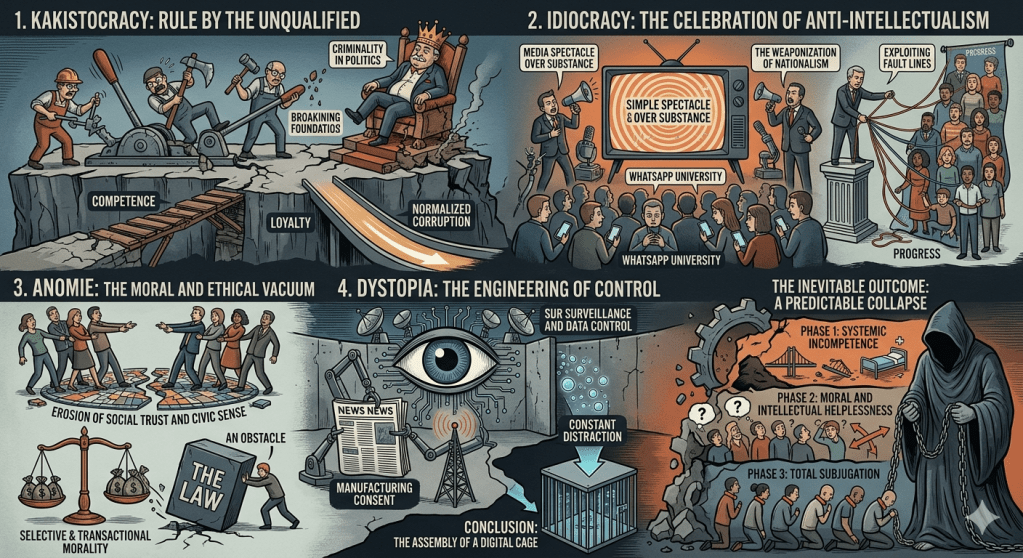
- Kakistocracy: Rule by the Unqualified
- A Political Class Without Vision
- Criminality in Politics and Society
- Competence vs. Loyalty
- Normalized Corruption
- Idiocracy: The Celebration of Anti-Intellectualism
- Media Spectacle Over Substance
- Exploiting Fault Lines Under the Guise of Progress
- The “WhatsApp University”
- The Weaponization of Nationalism: From Feedback to Insult
- Conclusion: The Cost of a Compromised Conscience
- Anomie: The Moral and Ethical Vacuum
- Erosion of Social Trust and Civic Sense
- The Law as an Obstacle, Not a Guide
- Selective and Transactional Morality
- Dystopia: The Engineering of Control
- Surveillance and Data Control
- Manufacturing Consent
- Constant Distraction
- Conclusion: The Assembly of a Digital Cage
- The Inevitable Outcome: A Predictable Collapse
- Phase 1: Systemic Incompetence
- Phase 2: Moral and Intellectual Helplessness
- Phase 3: Total Subjugation
India is a land of paradoxes. It is an ancient civilization reaching for a hyper-modern future, a vibrant democracy grappling with deep-seated social challenges, and a rising economic power where millions still face uncertainty and 700 million people receive state support for their basic food needs for survival.
While the narrative of a “New India” is one of strength and progress, a growing number of critics are asking a difficult question:
Are there signs of a deeper, systemic decay?
- To dismiss this question is easy.
- To explore it is painful, but necessary.
By applying four distinct political and sociological frameworks, we can analyze the worrying trends that, if left unchecked, could define the nation’s future.
This is not a verdict, but a critical examination of whether India is showing symptoms of being a kakistocracy, an ideocracy, a society in a state of anomie, and a developing dystopia.
1. Kakistocracy: Rule by the Unqualified
From the Greek words for “worst” (kakistos) and “rule” (kratos), a kakistocracy is a system governed by the least qualified and most unprincipled citizens.
This lens forces us to look at the state of Indian governance.
- The argument is that merit and morality are no longer the primary qualifications for power.
- Instead, power is often achieved through blind devotion, wealth, dynastic connections, and the ability to manipulate caste or religious sentiment.
This environment is fertile ground for the worship of individuals over institutions, encouraging people to revere politicians without critically understanding their policies or character, elevating them to a cult-like status where they can do no wrong.
How it manifests in India:
A Political Class Without Vision
A kakistocracy is defined by short-term thinking.
- This is compounded by a political class, across party lines, dominated by older leaders with no discernible long-term vision for nation-building.
- Their entire political calculus seems to revolve around the immediate goal of winning the next state election, rather than crafting 20- or 50-year plans for the country.
- Critics argue that many of these politicians are simply running out the last 10-15 years of their lives in positions of power, insulated from the negative consequences of societal decay and thus with little personal incentive to address it.
Criminality in Politics and Society
- A significant percentage of elected officials have criminal cases pending against them.
- This is mirrored in society where so-called spiritual leaders or “babas” operate with impunity, often backed by political connections secured through their large, unquestioning followings.
- In a kakistocracy, a criminal background or immoral character is not a disqualifier but is often seen as a sign of strength or “winnability.”
Competence vs. Loyalty
Key appointments in crucial National Institutions (which are considered the backbone of country) are frequently criticized for being based on political loyalty rather than expertise.
When the least competent are elevated, the institutions they lead begin to fail.
Normalized Corruption
The culture of “jugaad” has blurred the line between resourcefulness and outright corruption.
Public desensitization to scams is a hallmark of a society that has accepted rule by the unprincipled as the norm.
- Cheating Becomes the Norm: Creative shortcutting, once used just to survive, has now turned into an excuse to bend and break rules everywhere.
- Accepting the Corruption: People have seen so many scams that they no longer get shocked, treating bad behavior as just a normal part of life.
- Money Outweighs Morals: Society now praises anyone with a massive bank account, completely ignoring whether that wealth was stolen, cheated, or earned honestly.
- Ruining the Next Generation: When young people see dishonest people get all the respect and rewards, they lose any motivation to work hard and play by the rules.
2. Idiocracy: The Celebration of Anti-Intellectualism
An idiocracy describes a society where anti-intellectualism reigns, critical thinking is mocked, and the collective intelligence degrades to a point of functional helplessness.
The argument is that a deliberate dumbing-down is underway, making the population easier to control.
How it manifests in India:
Media Spectacle Over Substance
- Prime-time Indian media often seems to fabricate narratives to serve political masters.
- Rather than reporting on real issues like rising crime, education scams, or joblessness, they conduct high-decibel religious debates designed to polarize and distract.
This is amplified by online thinkers and YouTube influencers who monetize societal division or fault lines in society by fanning the flames of religion and casteism for views and engagement.
Exploiting Fault Lines Under the Guise of Progress
Everyone seems to take benefit of fault lines of society, from Politicians to Media to Youtubers, which should ideally be filled and corrected by these same people.
- Fake Advocacy for Profit: Media outlets and YouTubers pretend to highlight the struggles of ignored communities, but they actually use these sensitive issues just to spark outrage, gain views, and make money.
- Weaponizing Real Grievances: Instead of bringing people together to find real solutions for marginalized groups, these creators focus strictly on blame, which deepens division and turns different communities against one another.
- Drowning Out Real Solutions: By turning genuine social issues into loud, angry entertainment, online influencers and TV hosts ensure that constructive dialogue is lost, leaving the actual problems of the community completely unresolved.
- Turning Divisions into Votes: Politicians exploit this media-driven anger to secure easy vote-banks, winning elections by promising to protect one community from another rather than delivering real development.
The “WhatsApp University”
- Alternative Realities: The rampant spread of fake news has created a parallel reality for millions where fiction is accepted as absolute fact.
- Hostility Toward Facts: Critical thinking is not only absent but actively discouraged in favor of blind belief and forwarding sensational content.
- The Confirmation Bias Bubble: Algorithms and forwarded messages create echo chambers where people only receive information that confirms their existing prejudices, making them completely immune to evidence or logic.
- Weaponized Misinformation: False histories, doctored videos, and fabricated quotes are deliberately manufactured to stoke fear and hatred against specific communities, turning everyday citizens into unpaid agents of polarization.
- Family as the Trusted Source: Because misleading content is shared by trusted family members and friends, it bypasses the normal skepticism people might have for mainstream media, making the lies feel intimate, authentic, and safe to believe.
The Weaponization of Nationalism: From Feedback to Insult
- Branding Truth as Treason: Anyone who presents data-driven arguments that contradict popular narratives is quickly labeled “anti-national.”
- The Hypersensitivity Double Standard: There is a loud expectation for the world to be liberal and accommodating toward India, but a stubborn refusal to show that same openness in return.
- Feedback Dismissed as Insult: Critical feedback from foreign nationals is reflexively treated as a national insult rather than a helpful critique, triggering vicious online trolling.
- Ignorance Wrapped in Patriotism: In this hyper-defensive cultural environment, staying willfully blind to systemic flaws is actively promoted and celebrated as true patriotism.
Conclusion: The Cost of a Compromised Conscience
- When a society trades its moral compass for easy money, noisy distractions, and fake patriotism, it stops progressing.
- By rewarding dishonesty, letting media and politicians exploit our divisions, and trading real facts for forwarded rumors, we are building a culture based on anger rather than achievement.
- True growth does not come from silencing critics or winning arguments on social media; it comes from fixing our broken systems, demanding accountability, and creating a country where honest hard work is actually respected.
- If we do not stop rewarding the loudest and most corrupt voices, we risk teaching the next generation that truth and integrity simply do not matter.
3. Anomie: The Moral and Ethical Vacuum
The sociologist Émile Durkheim used “anomie” to describe a state of normlessness, where the moral fabric of society breaks down, and individuals lack clear ethical guidance.
When a society modernizes at a breakneck pace without a corresponding evolution in its ethical framework, it creates a moral vacuum, replaced by a ruthless, individualistic pursuit of wealth, status, or fleeting digital validation.
How it manifests in India:
Erosion of Social Trust and Civic Sense
There is a growing sense of “every person for themselves.”
- This is starkly visible in the paradox of people polluting the very rivers and religious sites they claim to worship.
- This lack of civic sense extends to new frontiers; motivated by travel videos, people crowd sacred natural places like mountains, polluting them and destroying their peace.
- The goal shifts from communion with nature or God to making reels for social media, turning a pilgrimage into a performance.
- This behavior travels abroad, where some Indian tourists create a negative impression by exporting a lack of communal respect through loud public behavior or littering.
The Law as an Obstacle, Not a Guide
- Circumvention Over Compliance: For many, the law is not a moral compass or a set of rules to live by, but simply a barrier to be cleverly bypassed.
- Casual Defiance: This disregard for rules is visible in everyday life, from routine traffic violations and public littering to large-scale tax evasion and corporate financial fraud.
- Weaponized Legal Machinery: The legal system is often used by the powerful as a tool to harass critics and tie them up in endless court battles, rather than to deliver swift justice.
- The Cost of Honesty: Because breaking the law has few consequences for the well-connected, following the rules is often penalized, making honest citizens feel like fools for trying to do the right thing.
- Justice Delayed and Denied: A massive backlog of cases and slow enforcement ensure that wrongdoing is rarely punished in real-time, encouraging people to take matters into their own hands or use bribes to speed things up.
Selective and Transactional Morality
- Weaponized Outrage: Public anger is rarely driven by a consistent moral code; instead, it is selectively turned on and off based on personal benefit, political alignment, or social media trends.
- The Corporate Moral Vacuum: The professional world lacks a collective work ethic, allowing toxic practices to thrive without any accountability.
- Glorifying Exploitation: Corporate founders can openly brag about demanding a slave-like culture—expecting employees to work 70 hours a week while paying them for a fraction of that time—without facing any social shame.
- Money as the Ultimate God: Society completely overlooks the deeply immoral character of ruthless figures because their wealth and status command absolute respect, proving that money has replaced integrity as the highest virtue.
4. Dystopia: The Engineering of Control
A dystopia is an imagined state in which there is great suffering or injustice. It relies on technology, surveillance, and propaganda to maintain control over a docile populace.
This is where the previous three conditions culminate. The literary warnings of Orwell and Huxley feel increasingly relevant as elements of a technologically-powered dystopia are assembled in plain sight.
How it manifests in India:
Surveillance and Data Control
- The Digital Noose: Linking every essential service to a single national ID (Aadhaar) turns basic citizenship rights into a system of constant, centralized tracking.
- Biometric Policing: The rapid deployment of facial recognition technology across public spaces creates a powerful infrastructure for real-time surveillance without public consent.
- The Threat of Social Control: Gathering vast amounts of personal data creates an immense potential for the state to monitor, predict, and control individual behavior, effectively chilling personal freedom.
Manufacturing Consent
- State-Driven Propaganda: A single, dominant narrative is relentlessly pushed by combining state-sponsored messaging with a submissive media that completely ignores real issues.
- The Language of Exclusion: Language is weaponized on a massive scale, using labels like “Anti-National” or “Pakistani Agent” to instantly silence and delegitimize any opposing view.
- Crushing Dissent: Critical voices, independent journalists, and data-driven arguments are systematically suppressed, ensuring that alternative perspectives rarely reach the mainstream public.
Constant Distraction
- Engineered Outrage: The populace is kept in a state of perpetual fury through manufactured religious controversies and non-stop political drama on prime-time television.
- The Influencer Smoke Screen: Social media influencers and online thinkers amplify societal divisions, keeping the public engaged in trivial cultural wars rather than meaningful debates.
- Hiding Systemic Failures: This constant noise acts as a deliberate shield, preventing any focused public attention on critical failures like unemployment, broken healthcare, or a toxic work culture.
Conclusion: The Assembly of a Digital Cage
The transition into a technologically-powered dystopia is not marked by a sudden crisis, but by the quiet, daily surrender of critical thinking and personal privacy.
When:
- Surveillance is branded as convenience,
- Propaganda is accepted as news, and
- Manufactured outrage replaces public debate,
- The infrastructure of total social control is complete.
By keeping the public trapped in a loop of constant distraction, those in power ensure that the collective energy of a nation is spent fighting manufactured cultural wars rather than demanding better schools, healthcare, or honest jobs.
- Ultimately, the danger is not just that these controlling tools exist, but that a heavily distracted public might willingly accept them.
- When citizens trade their freedom for safety, and facts for comforting lies, the warnings of a dystopian society stop being fiction and become an everyday reality.
The Inevitable Outcome: A Predictable Collapse
- The Slow Grind Downward: A society ruled by the worst, celebrating ignorance, losing its morals, and controlled by technology is on a dangerous path.
- The end will not be a sudden explosion, but a slow, painful, and predictable breakdown.
Phase 1: Systemic Incompetence
- Unqualified Leadership: Putting the wrong people in charge ensures that vital systems—like economic policies, hospitals, and infrastructure—are designed by the incompetent.
- Crumbling Foundations: The immediate result is collapsing bridges, failing healthcare, and financial ruin for everyday people.
- The Fake Paperwork: Instead of fixing these real-world breakdowns, those in power use manipulated headlines and fake data to mask the damage.
Phase 2: Moral and Intellectual Helplessness
- Blinded by Ignorance: Because the public has been taught to celebrate ignorance, they lose the ability to understand why their country is failing.
- Missing the Connection: People become unable to connect the cause (electing corrupt, unqualified leaders) with the effect (their own personal suffering).
- Chasing Scapegoats: Instead of demanding accountability, the confused population blindly follows media narratives that blame minority groups or outside enemies for their problems.
Phase 3: Total Subjugation
- Losing Self-Control: A population that is economically weakened and mentally confused completely loses the ability to think critically or govern itself.
- Begging the Autocrat: Out of desperation, citizens willingly hand over all their remaining rights to a strongman leader who promises to fix the exact chaos he helped create.
- The Death of a Civilization: The nation stops being a living society of free thinkers and becomes a stagnant, easily managed crowd, trapped under the weight of its own chosen ignorance.
 In the Pursuit of excellence
Leave a comment