- Who is Decaying?
- Why is it Unstable? A Battle of Forces and Energy
- What Happens During Decay? The Great Ejection
- A Biological Wrecking Ball: Why Radiation is Dangerous
- A Quick Note: Does Interaction Cause Decay?
- Connecting This Back to Superposition
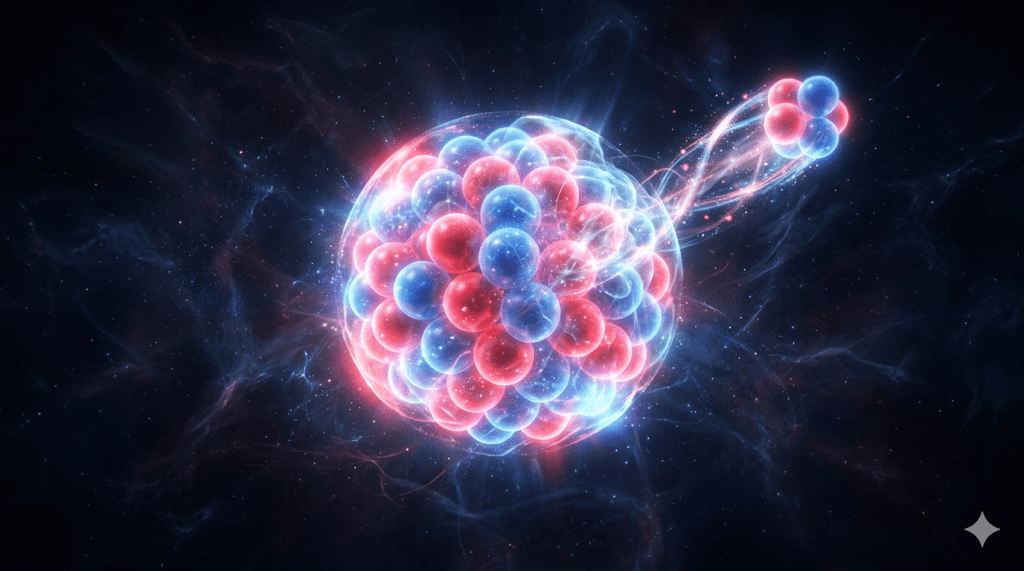
At the heart of everything we see and touch lies the atom. But for some atoms, this core is not a place of peace. It’s a tense, unstable environment locked in a constant struggle. This is the story of radioactive decay, a process where the very identity of an atom changes in a violent bid for stability.
Who is Decaying?
Brief Answer is: The Nucleus and its Isotopes.
- It’s not the whole atom, with its cloud of electrons, that’s unstable.
- It’s the tiny, incredibly dense core: the nucleus.
- Think of the nucleus as a tightly packed bundle of two types of particles: protons (positively charged) and neutrons (no charge).
What is an Element
The number of protons defines the element.
- Every single atom of Carbon has 6 protons.
- Every atom of Uranium has 92 protons.
- Change the number of protons, and you change the element entirely.
What is an Isotope
However, an element can have different numbers of neutrons. These variations are called isotopes.
For example:
- Carbon-12 has 6 protons and 6 neutrons. It is perfectly stable and makes up 99% of the carbon in your body.
- Carbon-14 has 6 protons and 8 neutrons. This imbalance makes its nucleus unstable and radioactive.
What is Radioactivity
This is the key: radioactivity is a property of specific, unstable isotopes of an element.
Let’s take a heavier example: Uranium.
- Atomic Number (Protons): 92
- Uranium-238 is the most common isotope. It has 92 protons and 146 neutrons (92 + 146 = 238). It’s radioactive, but with a very long half-life (about 4.5 billion years).
- Uranium-235 is a less common isotope. It has 92 protons and 143 neutrons (92 + 143 = 235). It’s also radioactive and is the key ingredient for nuclear power and weapons because it’s more easily split.
Why is it Unstable? A Battle of Forces and Energy
Two powerful forces are at war inside every nucleus larger than hydrogen:
- The Electromagnetic (Repulsive) Force: All 92 protons in a Uranium nucleus are positively charged. Just like holding two “north” ends of a magnet together, they desperately want to fly apart. This force is trying to tear the nucleus to pieces.
- The Strong Nuclear Force: This is an incredibly powerful, short-range “glue.” It is about 100 times stronger than the repulsion, but it only works over minuscule distances (about the width of a proton). It binds both protons and neutrons together.
Neutrons act as the crucial “peacemakers.” They add to the attractive Strong Nuclear Force without contributing any of the repulsive electromagnetic force, helping to hold the protons in check.
Instability arises when this delicate balance is broken:
- Too Big: In very large nuclei like Uranium, the nucleus is so big that protons on opposite sides are too far apart for the short-range Strong Force to hold them together effectively. The repulsion starts to win.
- Wrong Neutron-to-Proton Ratio: For smaller atoms, there is a “valley of stability.” An isotope with too many neutrons (like Carbon-14) is unstable. An isotope with too few neutrons (too many protons, like Carbon-11) is also unstable.
The unstable nucleus is in a higher-energy state than it needs to be. Nature always seeks the lowest possible energy state. A ball will roll down a hill; a hot cup of coffee will cool down. An unstable nucleus will shed mass and energy to become more stable. This is where Einstein’s famous equation, E = mc², comes in. During decay, a tiny amount of the nucleus’s mass is converted directly into a huge amount of energy, carried away by the ejected particles.
What Happens During Decay? The Great Ejection
“Decay” is the process where the nucleus spontaneously tries to reach a more stable, lower-energy state. To do this, it ejects a particle and/or energy. This is a physical, transformative event. Here are the primary ways it fixes its internal imbalance:
Alpha (α) Decay
- What it is: The nucleus spits out an “alpha particle,” which is just a helium nucleus (2 protons and 2 neutrons).
- Why it happens: This is the preferred decay method for very heavy nuclei (like Uranium-238) that are “too big.” It’s an efficient way to shed both mass and protons, reducing the repulsive force.
- Example: Uranium-238 (92 protons, 146 neutrons) decays into Thorium-234 (90 protons, 144 neutrons) plus an alpha particle. The Uranium atom literally becomes a Thorium atom.
`²³⁸U → ²³⁴Th + α`
Beta-Minus (β⁻) Decay
- What it is: A neutron inside the nucleus transforms into a proton, and the nucleus spits out a newly created, high-energy electron (the “beta particle”).
- Why it happens: This occurs in nuclei that have too many neutrons (like Carbon-14). It converts a “peacemaker” neutron into a proton, improving the neutron-to-proton ratio.
- Example: Carbon-14 (6 protons, 8 neutrons) decays into stable Nitrogen-14 (7 protons, 7 neutrons) plus a beta particle.
`¹⁴C → ¹⁴N + β⁻`
Beta-Plus (β⁺) Decay (Positron Emission)
- What it is: The opposite of Beta-Minus. A proton transforms into a neutron, and the nucleus ejects a positron (an anti-matter electron with a positive charge).
- Why it happens: This occurs in nuclei that have too many protons (are “proton-rich”). It reduces the repulsive force by getting rid of a proton.
- Example: Carbon-11 (6 protons, 5 neutrons) decays into Boron-11 (5 protons, 6 neutrons) plus a positron.
`¹¹C → ¹¹B + β⁺`
Gamma (γ) Decay
- What it is: The nucleus emits a “gamma ray”—an extremely high-energy photon of light.
- Why it happens: Often, after an alpha or beta decay, the new nucleus is still in an excited, high-energy state. It needs to “settle down.” It does this by releasing a burst of pure energy in the form of a gamma ray. The number of protons and neutrons doesn’t change, so the element remains the same. Think of it as the nucleus shuddering to release stress after a violent event.
- Example: A perfect real-world example is what happens after the decay of Cobalt-60, an isotope used in medical radiation therapy. Cobalt-60 first undergoes beta decay, transforming into Nickel-60. However, this newly formed Nickel-60 nucleus is typically left in a high-energy, “excited” state. It isn’t stable yet. To settle down, it almost instantly releases this excess energy by emitting one or more powerful gamma rays, finally becoming a stable, ground-state Nickel-60 atom. This second step is the gamma decay.
`⁶⁰Ni *→ ⁶⁰Ni + γ` (where the ‘*’ denotes the excited, high-energy state)
Summary of Radioactive Decay Processes
| Decay Type | What is Ejected? | Why it Happens | Effect on the Nucleus | Example |
|---|---|---|---|---|
| Alpha (α) | An alpha particle (2 protons + 2 neutrons) | The nucleus is too heavy or “too big” (e.g., Uranium). | Mass decreases; the atom transforms into a new element. | ²³⁸U → ²³⁴Th + α` |
| Beta-Minus (β⁻) | A high-energy electron | There are too many neutrons. | A neutron becomes a proton; the element changes. | ¹⁴C → ¹⁴N + β⁻` |
| Beta-Plus (β⁺) | A positron (anti-matter electron) | There are too many protons. | A proton becomes a neutron; the element changes. | `¹¹C → ¹¹B + β⁺` |
| Gamma (γ) | A gamma ray (high-energy light) | The nucleus is in an excited state after a previous decay. | No change to protons/neutrons; the element stays the same. | Excited Nucleus Stable Nucleus + |
A Biological Wrecking Ball: Why Radiation is Dangerous
All of these decay processes are hazardous because they produce ionizing radiation.
- Think of the ejected alpha particles, beta particles, and gamma rays not as gentle waves, but as microscopic, high-energy bullets.
- When one of these particles strikes a molecule within your body, its immense kinetic or electromagnetic energy is transferred, violently knocking electrons out of their orbits.
- This process, called ionization, breaks the stable chemical bonds that hold molecules together.
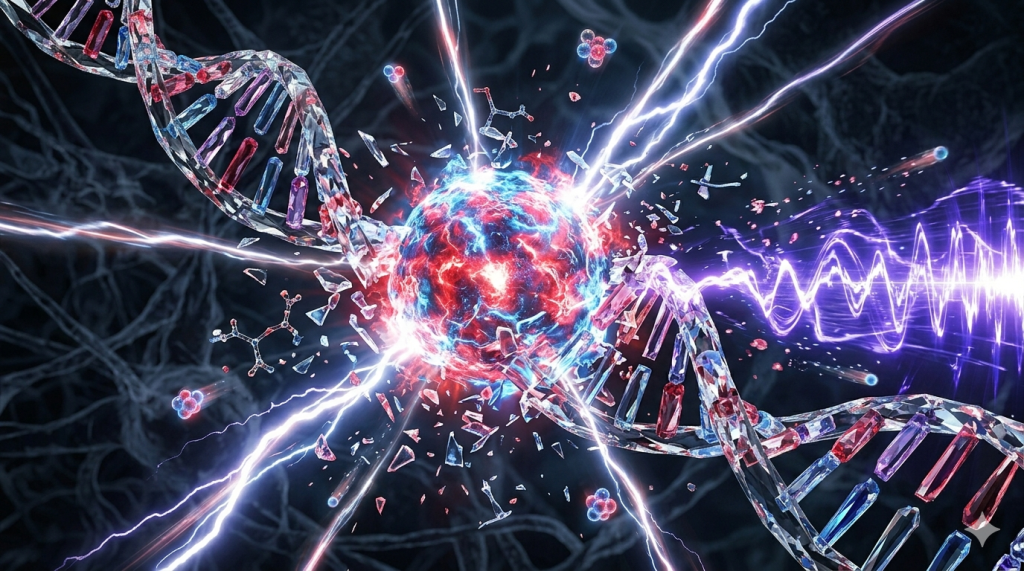
Types of Damage done to Human Cells?
This causes cellular chaos in two primary ways:
- Direct damage, where the radiation particle scores a direct hit on a critical macromolecule like DNA, severing its strands like a molecular scissor
- Indirect damage, which is far more common. In indirect damage, the radiation particle hits one of the trillions of water molecules in a cell, splitting it into highly reactive and unstable fragments known as free radicals (like the hydroxyl radical, •OH). These free radicals then swarm through the cell, acting as tiny chemical grenades that attack and damage other molecules, including DNA.
A cell with damaged DNA has three potential fates: it can die (apoptosis), it can malfunction, or it can mutate and begin to multiply uncontrollably, which is the origin of cancer.
Does the source of energy matters for human body damage?
The cell is an agnostic target; it doesn’t care whether the ionizing energy came from a decaying atom or a high-voltage machine.
The damage is caused by the type and amount of energy transferred, not its origin.
- Imagine the electromagnetic spectrum: at the low-energy end, radio waves and visible light pass through us or reflect off us without having enough energy to break chemical bonds. They are non-ionizing.
- But as you move up the spectrum to high-energy ultraviolet (UV) light, X-rays, and gamma rays, you cross a threshold. These have enough energy to ionize atoms.
- A high-energy X-ray photon produced by a hospital’s imaging machine is physically identical to a gamma ray photon of the same energy produced by a decaying cobalt-60 nucleus.
- To a cell, they are indistinguishable threats, capable of causing the exact same type of DNA-shattering damage.
Is the Damage Caused only by Photons?
The damage is not purely the result of photons hitting electrons; this is a crucial distinction that gets to the heart of radioactivity.
- While gamma rays are photons that cause damage by transferring their energy to electrons (via processes like the photoelectric effect or Compton scattering), alpha and beta decays eject massive, charged particles.
- An alpha particle (a helium nucleus) and a beta particle (an electron) are not photons. They cause ionization through electrostatic interaction.
- They don’t necessarily have to score a direct ‘hit’ on an electron; as these charged particles tear through tissue, their powerful electric fields rip electrons away from nearby atoms, leaving a trail of broken bonds and free radicals in their wake.
- Therefore, while the initial physical event at the atomic level is always the ejection of an electron, the agent causing that ionization can be a photon or a charged particle.
- The ultimate biological harm, however, consistently stems from the chemical chain reaction—the cascade of broken bonds and free radicals—that this initial ionization event unleashes within the cell.
A Quick Note: Does Interaction Cause Decay?
- This is a common point of confusion. The answer is no. Radioactive decay is a spontaneous process, meaning it is an intrinsic property of the unstable nucleus itself. It does not need an external trigger or interaction to happen. A lone Carbon-14 atom floating in the void of deep space will still decay on its own unpredictable schedule.
- The “interaction” is what allows us to observe that the decay has happened. The ejected alpha particle hitting a detector, the beta particle ionizing a gas in a Geiger counter—that is the interaction. It’s the effect, not the cause.
Connecting This Back to Superposition
This is where the strange and wonderful world of quantum mechanics takes over. For a single, isolated radioactive nucleus, we have absolutely no way of predicting when it will decay. It could happen in the next nanosecond, or in a million years.
According to quantum mechanics, as long as the nucleus is isolated, it exists in a superposition—a quantum blend of two states:
- State A: The “original, unstable nucleus” (e.g., the Uranium-238 atom).
- State B: The “new, stable nucleus + ejected particle” (e.g., the Thorium-234 atom and a flying alpha particle).
The nucleus is not in state A or state B; it is in a probabilistic combination of both.
The Role of Decoherence and Measurement
Now, what happens when this system interacts with the outside world, like in Schrödinger’s famous thought experiment?
- Decoherence and the Emergence of Probability: The unstable nucleus exists in a quantum superposition: a combination of both “|Not Decayed⟩” and “|Decayed⟩” states. The “|Decayed⟩” component of this superposition is linked to an ejected particle. The instant this potential particle interacts with its environment (e.g., the gas in a Geiger counter), the atom’s state becomes entangled with trillions of environmental particles. This rapid scrambling of the quantum state across a massive system is decoherence. This process destroys the clean superposition, transforming the quantum “and” (it’s decayed and not decayed) into a state that behaves, for all practical purposes, like a classical “or.” The system now acts as a probabilistic mixture: a 50/50 chance of being in the decayed branch or the not-decayed branch.
- Measurement and Collapse: This decohered system is now at a classical-like fork in the road. The “decayed” branch of the mixture is the one that triggers a macroscopic, irreversible chain of events—an avalanche of electrons in the Geiger counter, creating a current and an audible “click.” This click is the measurement. It is the moment of wavefunction collapse, where the probability is resolved into a single, definite reality. The “coin flip” has landed. At the sound of the click, the “not decayed” possibility vanishes, and the atom’s state is now, and only now, definitively 100% decayed.
The click of the Geiger counter is not the sound of the initial superposition collapsing; it’s the sound of one classical reality being cemented into place, long after decoherence has already wiped out the observable quantum effects.
IF you want to know more about Decoherence, you can read this blog:


Leave a Reply