Table of Contents
- Part 1: The Brain’s Survival Kit: How We Justify the Grind
- Cognitive Dissonance and the Sunk Cost Fallacy
- Hedonic Adaptation: The “New Normal”
- The “Urban Armor” of the Ego
- Part 2: The Social Contract: How We Turn Individual Struggle into Collective Identity
- “Urban Pride” and the Big Stage Effect
- The “Spirit” Myth: Romanticizing Resilience
- The Martyrdom Narrative: Sacrifice for the Next Generation
- Part 3: The High Cost of Pride: Mental Rot and Civic Stagnation
- Civic Stagnation: The “Spirit” as a Shield for Failure
- Psychological Decay: The “Mental Rot” of Normalized Misery
- Moral Decay: The Normalization of Illicit Success
- Stockholm Syndrome with the City
- The Bottom Line – State of Mental and Civic Decay
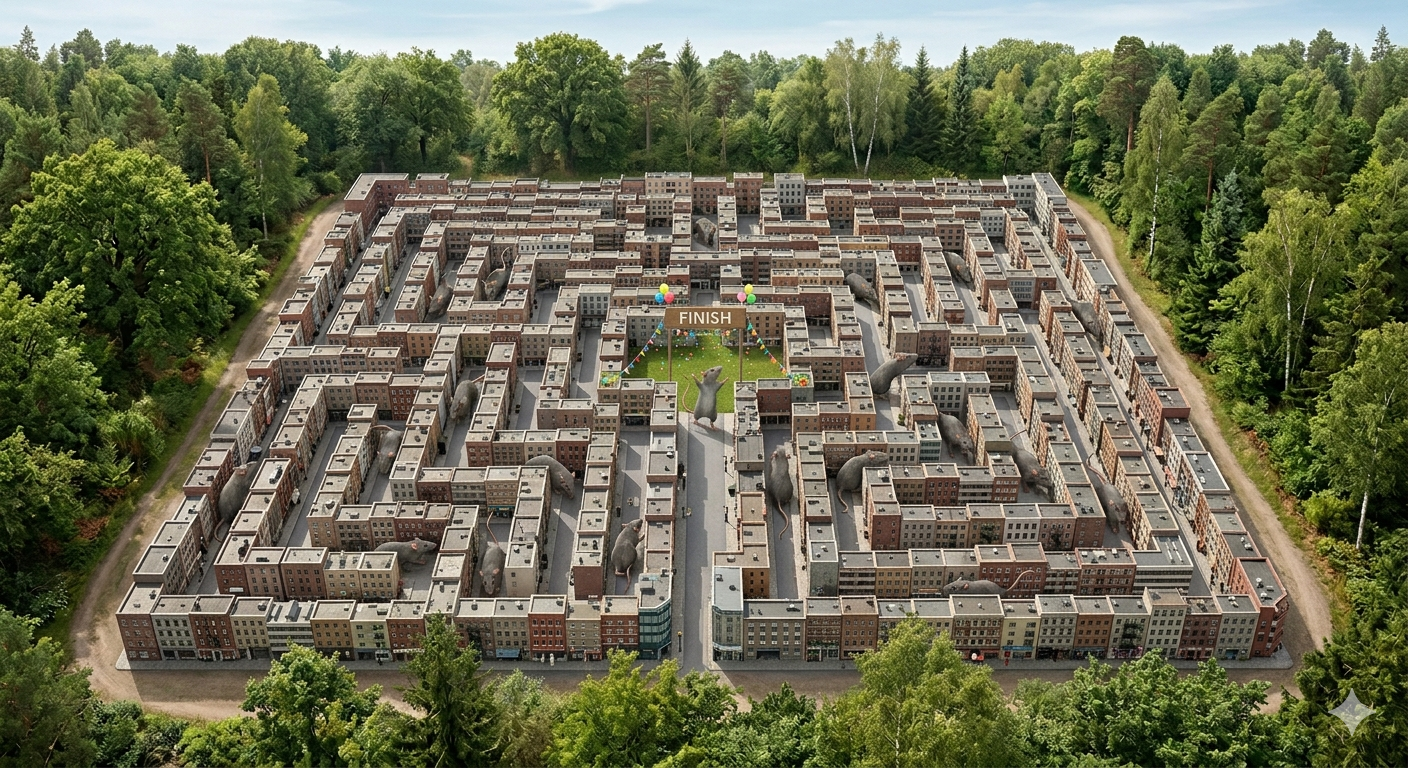
Whether it’s the “Spirit of Mumbai,” the grit of a “New York Tough” survivor, or the relentless hustle of London, millions of people live in cramped, expensive, and overcrowded conditions—and they are strangely proud of it.
To an outsider, it looks like a “rat colony.”
To a resident, enduring it feels like earning a badge of honor.
This isn’t simple pride. It’s a complex psychological phenomenon where the human mind, aided by powerful social narratives, transforms daily suffering into a heroic identity.
Here’s a breakdown of the psychology behind why we learn to love the cities that treat us so poorly, and the dangerous consequences of this mindset.
Part 1: The Brain’s Survival Kit: How We Justify the Grind
To survive a life that objectively seems miserable—spending half your salary on a shoebox apartment or two hours a day packed into a train like sardines—the brain employs a powerful set of coping mechanisms.
1. Cognitive Dissonance and the Sunk Cost Fallacy
- When you invest an enormous amount of effort, money, and time into a life, admitting it was a mistake is psychologically devastating. This is the core of Cognitive Dissonance.
- To resolve the conflict between “I suffer daily” and “I am a smart person who makes good choices,” the brain chooses to reframe the narrative.
- This is Effort Justification: we value a goal more if we had to suffer to achieve it.
- After investing 25 years in a grueling lifestyle, the brain converts suffering into a noble sacrifice. The story becomes: “I didn’t suffer for nothing; I survived what others couldn’t.” Pride becomes a defense mechanism against regret.
2. Hedonic Adaptation: The “New Normal”
- Humans are incredibly adaptable.
- Through a process called Hedonic Adaptation, the brain eventually stops registering chronic stressors like crowding and noise as threats.
- The chaotic commute or the tiny apartment becomes the “new normal”—the background noise of a successful life.
- This allows the resident to stop focusing on the constant misery and instead focus on the incremental rewards of city life, like a promotion or a night out.
3. The “Urban Armor” of the Ego
- To handle the sensory overload of a big city, residents develop what psychologists call “Urban Armor.”
- This is the hardened, seemingly uncaring exterior that allows them to navigate crowded streets.
- While an outsider sees this as cold and isolating, the resident reinterprets it as a sign of being a seasoned, tough, and sophisticated urbanite who can “handle” the pressure.
Over time, they may even look down on people from quieter places as “soft” or “weak,” using their own hardship to claim a kind of moral superiority.
Part 2: The Social Contract: How We Turn Individual Struggle into Collective Identity
Personal psychology is only half the story.
Society, media, and culture provide the scaffolding that helps build this pride.
1. “Urban Pride” and the Big Stage Effect
Sociologists call it “Urban Pride”: living in a famous city becomes a core part of an individual’s identity.
Psychologically, humans derive status from their environment.
Even if a personal slice of the city is tiny, an Individual gain “Social Capital” from proximity to power and action.
Saying “I am a Mumbaikar” or “I am a New Yorker” ties a person’s small, cramped life to a massive, powerful global brand, making him feel bigger than you are.
Economists note this is a trade-off: people often choose utility (money, status, ambition) over happiness (peace, space), finding an “equilibrium” where the benefits of the “rat race” outweigh the psychological costs.
2. The “Spirit” Myth: Romanticizing Resilience
Cities, politicians, and media are experts at mythmaking. They create narratives like the “Spirit of Mumbai” or “New York Tough” that frame systemic failures as tests of character.
- Absolving Accountability: This is a brilliant PR tool. These clichés are used to praise citizen resilience instead of addressing the need for safer, more livable infrastructure.
- Cinematic Glamorization: Movies and TV shows build the mythology of “The City” as the ultimate destination for success, where “hustle culture” is the only path.
The frenetic, crowded energy is framed as vibrant and essential, not dysfunctional. - Media Framing: News outlets often focus on sensational “human interest” stories of individual grit rather than investigative pieces on urban decay. By constantly hailing the “indomitable spirit,” the media normalizes suffering as a positive trait, not a policy failure.
3. The Martyrdom Narrative: Sacrifice for the Next Generation
- For many, particularly migrants and immigrants, “working like a dog” – 12-hour days and brutal commutes- is framed as a noble sacrifice.
- The pride comes not from the struggle itself, but from the identity of being a “Provider.”
- The parent endures the rat colony so their child can have a better future.
- This struggle is also seen as a victory when compared to the alternative—the economic stagnation or lack of opportunity in the village or country they left behind.
Part 3: The High Cost of Pride: Mental Rot and Civic Stagnation
When misery becomes a badge of honor, it acts as a powerful sedative, preventing both individuals and governments from seeking real improvement. This is where pride curdles into a form of decay.
1. Civic Stagnation: The “Spirit” as a Shield for Failure
If citizens are proud of their “indomitable spirit” in the face of a flood or a failing transit system, the authorities have no incentive to fix the root cause. When people celebrate their ability to survive “crush loads” on trains, they stop demanding more trains.
The struggle is rebranded as a virtue, making the demand for basic dignity sound like “complaining.”
As a result, the city remains stuck in a cycle of 1950s infrastructure serving today’s population.
2. Psychological Decay: The “Mental Rot” of Normalized Misery
Calling it “pride” often masks a darker psychological state, like Learned Helplessness or collective trauma.
Shrinking Horizons: After decades of an 8 AM-to-8 PM grind, a person’s ability to imagine a life with leisure, nature, or space withers away.
This is “Mental Rot”—the loss of the human capacity to want more than just survival.
The “Crab Mentality”: Those trapped in the struggle often develop a resentment towards anyone who seeks a better quality of life.
A 40-hour work week or a desire for space is seen as “lazy” or “soft,” as those trapped in struggle try to pull everyone down to their level of suffering to validate their own life choices.
Loss of Agency & Emotional Numbing: To survive, the brain must numb itself to the daily overload.
This numbing bleeds into personal relationships and self-care, leading to a hollowed-out existence where “pride” is the only strong emotion left. A person loses the power to believe that he can change circumstances.
3. Moral Decay: The Normalization of Illicit Success
This decay isn’t just mental; it’s often moral. For many newcomers from villages and smaller cities, the metropolis becomes a crucible that warps their ethical framework.
Young men and women, enticed by a glittery and often illicit lifestyle, may adopt behaviors they once would have condemned, rationalizing it without guilt as a necessary rite of passage for “living in the big city.”
This is mirrored by those who achieve financial success through immoral/questionable ways, corruption and malpractice. They don’t see it as a failing but as a savvy navigation of a brutal system, wearing their illicitly gained wealth as a badge of honor and proof of their victory in the urban jungle.
4. Stockholm Syndrome with the City
Over decades, residents can develop an emotional bond with the very system that treats them harshly. The shared trauma of a crowded train or a city-wide crisis creates a “war bond” with fellow citizens. They wear their stress like a medal, viewing it as a symptom of their importance. In reality, it is a symptom of a broken system that has ensnared its victims.
The Bottom Line – State of Mental and Civic Decay
When a society starts valuing “how much we can suffer” over “how well we can live,” it has entered a state of profound mental and civic decay.
There is a famous piece of wisdom:
The Rat Colony thrives not because it is a desirable place to live, but because the rats have been convinced that the maze is a palace.


Leave a Reply