Table of Content
- Understanding Time Dilation: How Speed and Gravity Affect the Passage of Time
- What Exactly is Time Dilation?
- Two Types of Time Dilation
- Special Relativistic Time Dilation
- The time dilation factor is given by the Lorentz factor, γ (gamma)
- Real-Life Example: The Twin Paradox
- Calculation to understand
- Gravitational Time Dilation
- Special Relativistic Time Dilation
- Why Time Dilation is Real: The Evidence
- The Hafele-Keating Experiment (1971)
- The Global Positioning System (GPS)
- Time Dilation on International Space Station
- Kinematic Time Dilation (Special Relativity)
- Gravitational Time Dilation (General Relativity)
- Net Effect
- Practical Significance
- Conclusion: The Mind-Bending Nature of Time

Understanding Time Dilation: How Speed and Gravity Affect the Passage of Time
Imagine if time could stretch and shrink depending on how fast you are moving or how close you are to something massive. What if time passed more slowly for you compared to someone else, just because you were traveling at a high speed or standing near a huge planet? While this might sound like science fiction, it is, in fact, a scientific reality, and it’s known as time dilation.
At the heart of time dilation lies a concept that challenges everything we’ve learned about time since childhood: time is not constant. It is not a universal, unchanging tick that moves forward for everyone at the same rate. Time, instead, is relative. How we experience time can vary depending on factors like speed or gravity.
What Exactly is Time Dilation?
Time dilation is a phenomenon described by Einstein’s theory of relativity. It states that time moves at different rates for observers who are in different frames of reference. The rate at which time passes is not universal but is influenced by the relative motion between two observers or the strength of the gravitational field they are in.
To understand this, imagine two people: one is in a spaceship traveling at a high speed through space, and the other is standing still on Earth. To the person on Earth, the clock on the spaceship will tick slower than their own, even though the two clocks are identical when they first start. This is because time is dilated (stretched out) for the person on the spaceship due to their high velocity relative to the observer on Earth.
Similarly, the strength of gravity affects the passage of time. A person near a massive object, like a black hole, will experience time at a different rate compared to someone farther away from the source of the gravitational pull. The closer you are to the source of gravity, the more slowly time will pass for you.
Two Types of Time Dilation
There are two main types of time dilation: special relativistic time dilation and gravitational time dilation. Each arises from different aspects of relativity: one from high speeds and the other from gravitational fields.
1. Special Relativistic Time Dilation
Special relativistic time dilation happens when objects are moving at significant fractions of the speed of light relative to each other. Einstein’s theory of special relativity tells us that as an object approaches the speed of light, time will slow down for it relative to someone who is stationary. The faster you move, the slower time passes for you in comparison to a stationary observer.

Imagine a spaceship traveling at 90% of the speed of light. If an astronaut on the ship looks at a clock, it ticks at the normal pace for them. But to someone observing from Earth, the clock aboard the spaceship appears to tick more slowly. The time dilation factor, often represented by gamma (γ), mathematically describes how much time is dilated. It is given by the formula:
The time dilation factor is given by the Lorentz factor, γ (gamma)
Time dilation factor (γ) = 1 / sqrt(1 – v^2/c^2)

Where:
- v is the relative velocity between the two objects.
- c is the speed of light in a vacuum.
The closer the velocity (v) is to the speed of light (c), the greater the value of gamma (γ), which means the greater the time dilation effect. At speeds near the speed of light, time almost stops for the moving object relative to a stationary observer. The astronaut on the spaceship might experience just a few years of travel, while decades, centuries, or even longer could pass for people back on Earth.
Real-Life Example: The Twin Paradox
A classic thought experiment that illustrates special relativistic time dilation is the twin paradox. In this scenario, two identical twins are born at the same time. One twin stays on Earth, and the other takes a spaceship trip at a speed close to the speed of light. When the traveling twin returns to Earth after many years, they will be younger than their sibling who stayed on Earth. This happens because time passed more slowly for the traveling twin due to their high speed.
Even though both twins have experienced time passing normally within their own reference frame, the twin who traveled in space has experienced a dilated (slower) passage of time compared to the twin who remained on Earth.
Calculation to understand
Imagine someone travels through space at 80% of the speed of light for a total of 2 years, with 1 year going in one direction and 1 year returning. How much younger would this person be compared to someone who stayed on Earth?
To calculate the time difference, we’ll use the Lorentz factor, γ (gamma), which is given by:
γ = 1 / sqrt(1 – v^2/c^2)
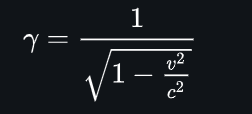
where:
v = 0.8c (speed of the traveler)
c = speed of light
Plugging in the values, we get:
γ = 1 / sqrt(1 – (0.8c)^2/c^2)
= 1 / sqrt(1 – 0.64)
= 1 / sqrt(0.36)
= 1 / 0.6
= 1.6667
Now, we’ll use the time dilation formula:
t’ = γ(t)
where:
t’ = time experienced by the traveler
t = time experienced by the person on Earth
Since the traveler is moving at 0.8c for 2 years (1 year to travel and 1 year to return), we’ll calculate the time dilation for the entire 2-year period:
t’ = γ(t)
= 1.6667(1 years)
= 1.6667 years (for one way)
Since the traveler is going for 1 year and returning for another year, the total time experienced by the traveler would be:
2 x 1.6667 years = 3.3334 years
This is the time experienced by the person on earth i.e 3.3334 years.
Time difference = Time experienced by person on Earth – Time experienced by traveler
= 3.3334-2
= 1.3334
So, the traveler has aged approximately 1.33 years LESS than the person on Earth.
Or Person on Earth has aged 1.333 Years more than traveler.
2. Gravitational Time Dilation
Gravitational time dilation occurs when an object is in a strong gravitational field. According to Einstein’s theory of general relativity, gravity also affects the passage of time. The stronger the gravitational field, the slower time passes for an object in that field.
For example, if you were standing on the surface of Earth and someone else were in a spaceship far away from any massive objects, you would both experience time normally in your own frames. However, because Earth has a gravitational field, time would pass more slowly for you compared to the person in the spaceship.

If you were near a massive object like a black hole, the difference would be even more extreme. Near a black hole, the gravitational field is so intense that time can slow down dramatically. For someone standing near the event horizon of a black hole, time would pass almost infinitely slow compared to someone far away in deep space.
This effect is one reason why time dilation is so important in understanding phenomena near massive bodies in space, like black holes, neutron stars, or even our own planet. If you could orbit a black hole for a short period of time and then return to Earth, you would find that many years, possibly even centuries, had passed on Earth while only a few days or hours had passed for you.
Why Time Dilation is Real: The Evidence
Time dilation might sound like science fiction, but it has been confirmed by multiple experiments and real-world applications.
1. The Hafele-Keating Experiment (1971)
This famous experiment demonstrated special relativity’s predictions in the real world. In the 1970s, physicists Joseph Hafele and Richard Keating flew atomic clocks on commercial airplanes around the world and compared them with identical clocks that remained stationary on the ground. When the planes landed, the clocks on board had ticked slightly slower than those on the ground, confirming that time had indeed passed at different rates for the moving clocks due to their high velocities.
2. The Global Positioning System (GPS)
GPS satellites orbit the Earth at speeds of around 14,000 km/h and are located 20,000 kilometers above Earth’s surface. As a result, they experience both special relativistic time dilation (because of their speed) and gravitational time dilation (because they are farther from the Earth’s gravitational field). Without accounting for these effects, the clocks on GPS satellites would drift by about 38 microseconds per day. Over time, this small discrepancy would result in significant errors in navigation, potentially leading to location errors of several kilometers.
Engineers working on the GPS system have to make these relativistic adjustments to ensure the system works accurately, even though the effects of time dilation are minuscule in everyday life.
Time Dilation on International Space Station
Astronauts aboard the International Space Station (ISS) experience time dilation effects due to two key relativistic factors: kinematic time dilation and gravitational time dilation. These effects arise from their high velocity relative to Earth and their position in a weaker gravitational field, respectively.
1. Kinematic Time Dilation (Special Relativity)
The ISS orbits Earth at a speed of about 28,000 km/h (17,500 mph), which is roughly 7.66 km/s. According to Einstein’s theory of special relativity, time for an object moving at high speeds relative to a stationary observer slows down. In the case of the ISS, this results in slightly slower passage of time for astronauts onboard compared to someone on Earth. The time dilation caused by this high speed is very small, and after a full day, it amounts to a decrease of approximately -0.00002646 seconds.
2. Gravitational Time Dilation (General Relativity)
The ISS orbits at an altitude of about 400 kilometers above Earth, where the gravitational field is weaker than on Earth’s surface. According to general relativity, time passes faster in weaker gravitational fields. This means that clocks on the ISS tick slightly faster than those on Earth due to the weaker gravity at that altitude.
Net Effect
The combined result of both effects (kinematic and gravitational) determines how much time actually passes for astronauts relative to people on Earth.
While special relativity causes time to run slower due to the ISS’s high velocity, the weaker gravitational field at the ISS altitude causes time to run slightly faster. The net effect is that astronauts age slightly less than people on Earth.
However, the time dilation is extremely small:
- For a typical 180-day stay on the ISS, astronauts experience a time dilation of about -0.0048 seconds (meaning they age about 0.0048 seconds less than people on Earth).
- To age just one second younger than someone on Earth, an astronaut would need to stay on the ISS for about 140 years.
Practical Significance
While the difference in aging is real, it is so small that it is not detectable in everyday life. Astronauts would not notice any tangible effects from the time dilation, and it would not impact their health or aging in any meaningful way. The time dilation is primarily of interest for precision measurements, such as those made with atomic clocks, and for understanding the broader implications of relativity.
In comparison, for GPS satellites orbiting higher than the ISS, the gravitational time dilation effect dominates, so their clocks tick slightly faster than those on Earth. This is why adjustments must be made to account for both special and general relativistic effects when operating GPS systems.
In summary, while time dilation on the ISS is a real phenomenon, its practical impact is extraordinarily small and not noticeable in daily life.
Conclusion: The Mind-Bending Nature of Time
- Time dilation shows us that time is not the same for everyone, everywhere, or at all times.
- Whether it’s high-speed travel or the pull of gravity, time can stretch and compress, altering how we experience it.
- The fascinating implications of time dilation challenge our understanding of reality, offering us a glimpse into how the universe truly works.
So, the next time you hear someone say, “Time flies when you’re having fun,” you might just think: is that the truth, or is time playing a trick on us?
Time dilation is not only a mind-bending concept but also a key part of the science that shapes our universe, proving that even something as fundamental as time can be more fluid than we ever imagined.


Leave a Reply