Table of Content
- The Primordial World – A Planet Without Breath
- The Spark of Genius – A New Way to Eat the Sun
- Rusting a Planet – The Great Oxidation Transition
- A Global Catastrophe, A Future Panacea
- First, the Catastrophes
- Then, the Panacea
- The Long Pause – The “Boring Billion”
- A Breath of Ancient Air
Take a deep breath. That rush of life-giving oxygen, the very gas that powers our bodies and makes our vibrant world possible, feels like a permanent and fundamental feature of Earth. But for the first half of our planet’s history, it was almost entirely absent. The air we breathe is not a geological given; it is a biological invention.
The story of how our atmosphere was transformed from a toxic cocktail into a breathable haven is the story of a planetary takeover by one of the humblest, yet most powerful, life forms imaginable: phytoplankton. Specifically, their ancient ancestors, cyanobacteria. This is the story of how a little green slime poisoned a planet to save it.
The Primordial World – A Planet Without Breath
Imagine Earth, four billion years ago. It’s an alien world. The sky is a hazy orange, not blue. The oceans are a murky green, rich in dissolved iron. The atmosphere is a thick blanket of methane, carbon dioxide, and ammonia, with virtually no free oxygen. In fact, that atmosphere was supercharged with methane, a greenhouse gas over 25 times more potent than carbon dioxide, which kept the planet warm under a faint young sun.
Life did exist, but it was nothing like we know. In the deep oceans, sheltered from the sun’s harsh, unfiltered ultraviolet (UV) radiation, single-celled microbes thrived. They were anaerobic, meaning they lived without oxygen. To them, oxygen wasn’t just unnecessary; it was a violent, corrosive poison that would tear their cellular machinery apart. For over a billion years, these simple organisms were the sole rulers of the planet.
The Spark of Genius – A New Way to Eat the Sun
Life’s first great innovation was photosynthesis—the ability to convert sunlight into energy. The earliest photosynthesizers used simple compounds available in the ocean, like hydrogen sulfide (the stuff that smells like rotten eggs). It was an effective, if limited, strategy.
Then, around 3 billion years ago, a new type of microbe evolved: cyanobacteria. These organisms, often called blue-green algae, stumbled upon a biological masterstroke. They developed a new, more powerful form of photosynthesis called oxygenic photosynthesis. Instead of using scarce materials like hydrogen sulfide, they figured out how to use the most abundant resource on the planet: water (H₂O).
By using sunlight to split water molecules, cyanobacteria could generate enormous amounts of energy. But this revolutionary process had a byproduct. A waste gas. That waste was free oxygen (O₂) a highly reactive, volatile gas.
For the first time, Earth had a life form that was actively pumping the poison of the old world into the oceans. The fuse had been lit.
Rusting a Planet – The Great Oxidation Transition
For hundreds of millions of years, the world didn’t change much. Geochemical evidence suggests there were temporary, localized “whiffs of oxygen” as cyanobacteria began their work, but it was quickly consumed. The oxygen they produced didn’t escape into the air. Instead, it immediately reacted with the vast quantities of dissolved iron in the seawater.
The result was a planetary-scale chemical reaction: the rusting of the oceans. The oxygen bonded with the iron, forming iron oxides that rained down onto the seafloor, layer by layer. Today, these ancient layers are visible to us as massive geological formations called Banded Iron Formations (BIFs)—beautiful, rust-colored stripes in rock that serve as a fossil record of the world’s first breaths.
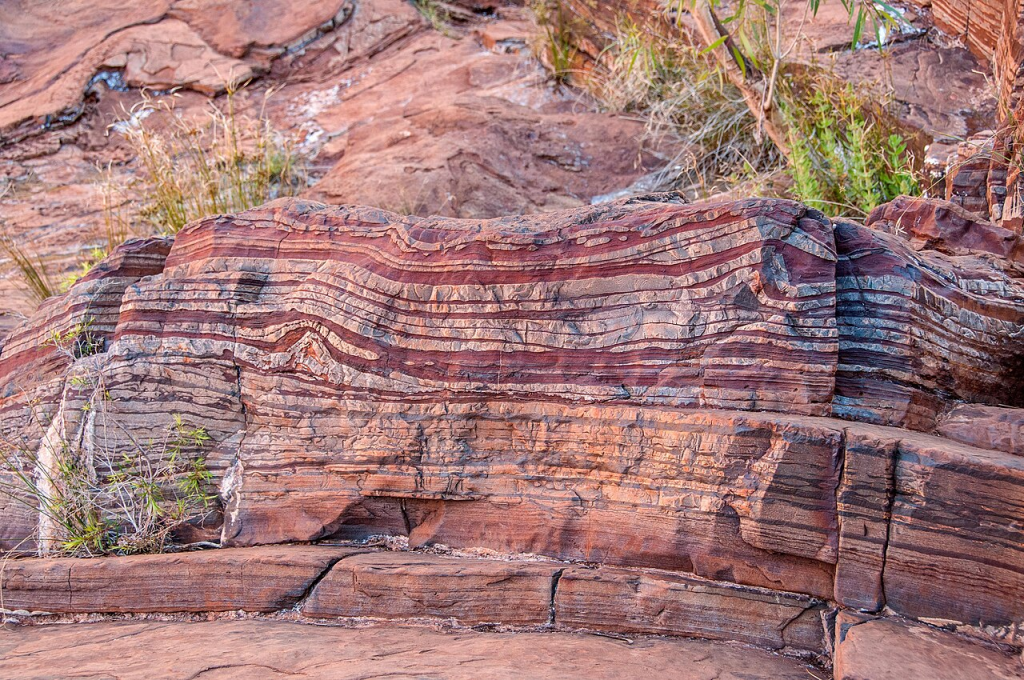
But BIFs are just one chapter in this rocky story. Scientists have found other geological fingerprints to trace this transition. Before oxygen, minerals like pyrite (“fool’s gold”) and uraninite could be washed into rivers and deposited as solid grains. After oxygen appeared, they would have instantly rusted and dissolved, so they vanish from riverbed deposits younger than 2.4 billion years old. Conversely, this is when we first see widespread “red beds”—terrestrial sandstones stained red by rust, proving oxygen was now in the atmosphere and on land.
Finally, around 2.4 billion years ago, the oceanic and terrestrial “sinks” ran out of material to rust. With the iron sink exhausted, the oxygen produced by the relentless cyanobacteria had nowhere else to go. It saturated the oceans and began to pour out into the atmosphere in unimaginable quantities. This period is called the Great Oxidation Event (GOE), though it was less a sudden “event” and more of a long, sputtering transition that would fundamentally remake the world.
A Global Catastrophe, A Future Panacea
The GOE was two things at once: the planet’s greatest series of catastrophes, and the dawn of a new age of possibility.
First, the Catastrophes
The Oxygen Holocaust: For the dominant anaerobic life, the flood of oxygen was an apocalypse. This toxic gas destroyed organisms that weren’t equipped to handle it, wiping out an estimated 99% of life on Earth in the planet’s first and greatest mass extinction.
The Climate Catastrophe: The devastation wasn’t just biological; it was climatic. As oxygen filled the air, it reacted with the powerful greenhouse gas methane, converting it into far weaker carbon dioxide and water. The planet’s heating blanket was effectively shredded. Global temperatures plummeted, triggering the Huronian Glaciation, a “Snowball Earth” period that may have encased the entire planet in ice for nearly 300 million years. The life that poisoned the air now found itself in a global deep-freeze.
Then, the Panacea
And yet, from this twin apocalypse of poison and ice, the seeds of our modern world were sown.
The Energetic Jackpot: A few microbes evolved defenses against oxygen, and some went even further: they evolved to use it. This was the birth of aerobic respiration. Using oxygen to process food is about 16 times more energy-efficient than anaerobic methods. This massive energy surplus was the fuel that powered complexity, allowing for the evolution of larger, more sophisticated eukaryotic cells—the cell type that makes up all animals, plants, and fungi.
Creating a Planetary Sunscreen: High in the atmosphere, some of the new oxygen molecules (O₂) were struck by the sun’s powerful UV radiation and converted into ozone (O₃). This formed the ozone layer, a planetary shield that absorbed the most dangerous UV rays and allowed life to eventually colonize the land. Without it, there would be no forests, no insects, no dinosaurs, and no humans.
The Long Pause – The “Boring Billion”
One might assume that once oxygen was present and eukaryotes had evolved, the race toward complex life was on. But that’s not what happened. The period from roughly 1.8 to 0.8 billion years ago is often called the “Boring Billion.”
Despite the presence of oxygen, evolution seemed to stall. Life remained largely simple and microbial. Scientists are still debating why. Perhaps oxygen levels, while present, remained too low to support large, active animals. Perhaps the oceans were missing other key nutrients. The GOE was the crucial first step, but it wasn’t the whole story. It would take another, later rise in oxygen to finally fuel the Cambrian Explosion and the riot of animal life that followed.
A Breath of Ancient Air
From a single-celled innovation came the air in our lungs, the energy in our cells, and the shield that guards our planet. The humble phytoplankton, starting with their cyanobacterial ancestors, are the unsung architects of our world. They terraformed a hostile planet, committing a mass extinction and triggering a global ice age that, paradoxically, created the energetic and atmospheric conditions necessary for all complex life to follow.
So the next time you stand outside, look up at the blue sky, and take a deep breath, remember the tiny drifters of the sea.
You are breathing an atmosphere that was built, breath by ancient breath, by humble Phytoplankton and their ancestors – Cyanobacteria.
 In the Pursuit of excellence

Leave a comment