- Etymology: What is ‘Plankton’?
- How is Plankton Further Divided?
- Division by Trophic Group (How they get energy)
- Division by Life Cycle
- Division by Size
- What are Phytoplankton
- Why Can’t We See Them? (The Microscopic Scale)
- Pillar 1: The Foundation of All Marine Life (Primary Producers)
- Pillar 2: The Planet’s Lungs (Oxygen Production)
- Pillar 3: A Critical Carbon Sink (The Biological Carbon Pump)
- The Great Graze: How Zooplankton Fuel the Food Web
- A Fragile Foundation: Threats to Phytoplankton
- Our Connection to the Microscopic
Etymology: What is ‘Plankton’?
Etymologically, the word plankton comes from the Greek adjective _planktos_ , which means “wanderer” or “drifter.”
This name was chosen by the German biologist Victor Hensen in 1887 to describe the vast collection of organisms that are passively carried along by ocean currents and tides. The defining characteristic is not their size, but their inability to swim powerfully enough to move against the flow of water.
This is in direct contrast to nekton, another term derived from Greek (_nēktos_, νηκτός, meaning “swimming”), which describes organisms that can actively swim and propel themselves through the water, such as fish, whales, and squid.
So, etymologically, plankton are the “drifters” of the aquatic world, while nekton are the “swimmers.”
This means planktons drift with ocean currents and nekton can swim with or against ocean currents.
How is Plankton Further Divided?
Plankton is an incredibly diverse group, and scientists divide it in several key ways:
A. Division by Trophic Group (How they get energy)
This is the most fundamental division, separating the “plants” from the “animals.”
- Phytoplankton (“Plant” Plankton): From the Greek _phyton_ (plant). These are autotrophic organisms that produce their own food through photosynthesis. They form the base of the aquatic food web. Examples: Diatoms, coccolithophores, dinoflagellates, and cyanobacteria.
- Zooplankton (“Animal” Plankton): From the Greek _zōion_ (animal). These are heterotrophic organisms that must consume other organisms for energy. They are the primary grazers of phytoplankton. Examples: Copepods, krill, jellyfish, and the larval stages of many larger animals.
- Bacterioplankton: This category includes free-living bacteria and archaea. They play a critical role in decomposing organic matter and recycling nutrients in the water.
B. Division by Life Cycle
- Holoplankton: Organisms that spend their entire life as plankton. Examples: Copepods, diatoms, jellyfish.
- Meroplankton: Organisms that only spend a part of their life (usually the larval stage) as plankton before growing into a larger form that is either nektonic (swimming) or benthic (living on the seafloor). Examples: The larvae of crabs, barnacles, starfish, clams, and most fish.
C. Division by Size
This is a formal classification used by oceanographers.
| Category | Size Range | Examples |
|---|---|---|
| Megaplankton | > 20 cm | Large jellyfish, salp chains |
| Macroplankton | 2 – 20 cm | Krill, small jellyfish, ctenophores |
| Mesoplankton | 0.2 – 20 mm | Copepods, foraminifera, larval fish |
| Microplankton | 20 – 200 µm | Most phytoplankton, large protozoa |
| Nanoplankton | 2 – 20 µm | Smaller phytoplankton (coccolithophores) |
| Picoplankton | 0.2 – 2 µm | Cyanobacteria, other bacteria |
| Femtoplankton | < 0.2 µm | Marine viruses (Virioplankton) |
What are Phytoplankton
Take a deep breath. Now take another. One of those breaths you just took was made possible not by a tree, but by a microscopic organism drifting in the sunlit zone of the ocean.
They are the “invisible forests” of our planet. While each one is a single-celled life form, too small to be seen with the naked eye, their collective global impact is as significant as all the jungles, forests, and grasslands on land combined.
They are phytoplankton, and they are arguably the most important organisms on Earth.
But what are they, and what makes them so vital to our very existence?
Why Can’t We See Them? (The Microscopic Scale)
Before diving into their colossal roles, it’s worth understanding their scale. You can’t see individual phytoplankton because they are incredibly small, ranging from a few micrometers (µm) to a few hundred micrometers in diameter. To put that in perspective, a human hair is about 70 micrometers thick. This means hundreds of the smaller phytoplankton could fit on the head of a pin.
While individuals are invisible, their collective presence can be spectacular.
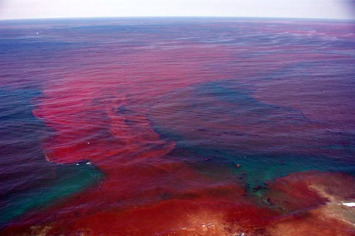
When conditions are right (plenty of sunlight and nutrients), they reproduce rapidly in an event called a “bloom.” During a bloom, the concentration of cells can be so high—millions of cells per liter of water—that they change the color of the ocean’s surface.
These massive blooms can be seen from space, painting the oceans in surreal swirls of:
- Milky turquoise, caused by coccolithophores covered in calcium carbonate plates.
- Vibrant green, caused by vast populations of diatoms.
- Reddish-brown, the sign of a “red tide,” often caused by dinoflagellates.


Pillar 1: The Foundation of All Marine Life (Primary Producers)
- Phytoplankton are autotrophs, meaning they produce their own food. Through the process of photosynthesis, they use sunlight, carbon dioxide (CO₂), and dissolved nutrients (like nitrates and phosphates) to create organic matter (sugars and fats). This process makes them the primary producers of the aquatic world.
- Ecological Importance: In ecology, energy flows through ecosystems via trophic levels. Phytoplankton form the very first trophic level. They are the foundation upon which nearly all marine life is built.
- Energy Transfer: They are the critical link that captures solar energy and converts it into chemical energy, making it available for the rest of the ecosystem. When they are eaten, this energy is transferred to the next trophic level.
The Food Chain sequence looks like this:
- Phytoplankton (producers) are eaten by…
- Zooplankton (primary consumers), which are then eaten by…
- Small fish, crustaceans, and other invertebrates (secondary consumers), which are then eaten by…
- Larger fish, seabirds, and marine mammals (tertiary consumers and apex predators).
Without phytoplankton, this entire food web would collapse. It would be like removing the bottom layer of a pyramid; everything above it would tumble down. There would be no new energy entering the system, leading to mass starvation and the extinction of most marine species.
Pillar 2: The Planet’s Lungs (Oxygen Production)
A crucial byproduct of photosynthesis is oxygen. While we often credit rainforests for our breathable air, phytoplankton in the oceans are responsible for producing between 50% and 80% of the Earth’s oxygen.
Ecological Importance:
- Atmospheric Stability: This massive oxygen output is fundamental to maintaining the composition of our atmosphere, making complex life on land possible. Every other breath you take is a gift from the sea.
- Oceanic Respiration: The oxygen they produce doesn’t just go into the atmosphere. Much of it dissolves directly into the water. This dissolved oxygen is what nearly all marine animals—from zooplankton to fish to whales—use for respiration. Without it, the oceans would become vast anoxic (oxygen-deprived) dead zones, unable to support the life we know.
Pillar 3: A Critical Carbon Sink (The Biological Carbon Pump)
To perform photosynthesis, phytoplankton absorb dissolved CO₂ from the surface water.
As they absorb it, more CO₂ from the atmosphere dissolves into the ocean to maintain equilibrium.
This process effectively pulls the greenhouse gas CO₂ out of the atmosphere.
Ecological Importance: This role in the global carbon cycle is known as the “biological carbon pump.”
- Carbon Sequestration: When phytoplankton die, a portion of them sinks to the deep ocean. The carbon locked within their bodies is transported to the depths, where it can remain for hundreds or thousands of years. Some of it eventually becomes part of the seafloor sediment, effectively sequestering that carbon for millions of years.
- Climate Regulation: By removing vast quantities of CO₂ from the atmosphere, phytoplankton act as a global thermostat, helping to regulate Earth’s climate. Without this process, atmospheric CO₂ levels would be much higher, severely accelerating global warming and its consequences.
The Great Graze: How Zooplankton Fuel the Food Web
So if phytoplankton are the “grass” of the sea, who are the “cows”?
Enter the zooplankton.
These tiny animals drift in the water and are the primary grazers of phytoplankton, forming the crucial link between the producers and the rest of the food web.
They consume phytoplankton using several methods:
1. Filter Feeding: This is the most common method. Many zooplankton, like the abundant copepods, generate tiny water currents with their beating appendages. They draw water towards themselves and pass it through fine, hair-like structures that act like a sieve, trapping phytoplankton cells, which they then consume.
2. Raptorial Feeding (Direct Interception): Some larger zooplankton can actively hunt and grab individual phytoplankton cells. This is more common when the phytoplankton are larger, such as long chains of diatoms.
3. Mucous Nets: Some gelatinous zooplankton, like salps and larvaceans, create a net of mucus to trap food. As they drift, water flows through the net, and phytoplankton get stuck. Periodically, the animal consumes the entire mucus net, along with all the food it has collected.
This constant grazing by zooplankton is what transfers the sun’s energy, initially captured by phytoplankton, into the animal kingdom, fueling the entire oceanic ecosystem.
A Fragile Foundation: Threats to Phytoplankton
Despite their power, phytoplankton populations are vulnerable. Human activity is altering the world’s oceans in ways that pose a direct threat to these vital organisms:
- Climate Change and Ocean Warming: As ocean temperatures rise, it creates a more stratified “layered” ocean. This makes it harder for nutrient-rich deep water to mix with the sunlit surface where phytoplankton live, essentially starving them. Changing temperatures also shift phytoplankton populations, favoring some species over others, which can disrupt the entire food web that has evolved to rely on specific types.
- Ocean Acidification: The same CO₂ that causes global warming is also being absorbed by the ocean, making it more acidic. This is particularly dangerous for phytoplankton like coccolithophores, which build their protective shells from calcium carbonate—a material that dissolves in acidic conditions.
- Nutrient Pollution: Runoff from agriculture and urban areas can dump excessive nutrients (nitrogen, phosphorus) into coastal waters. While this might seem like a good thing, it often leads to explosive, uncontrolled blooms of a few—often toxic—species. When these massive blooms die and decompose, the process consumes all the dissolved oxygen in the water, creating hypoxic “dead zones” where other marine life cannot survive.
Our Connection to the Microscopic
From the air we breathe to the climate we depend on and the seafood we eat, our world is inextricably linked to the health of these invisible powerhouses. They are not just a curious part of a distant ocean; they are the life-support system for the entire planet.
Understanding their importance is the first step. Protecting their ocean home from pollution, acidification, and rapid warming is the necessary next step.
The fate of the largest whale is tied to the smallest plankton, and so, in turn, is ours.
The next time you look out at the ocean, remember the unseen engines churning within it—the silent, microscopic majority that makes our world possible.
 In the Pursuit of excellence
Leave a comment