- RNA Transcription
- Messenger RNA (mRNA)
- Transfer RNA (tRNA)
- Ribosomal RNA (rRNA)
- Other Regulatory RNAs
- The Indispensable Role of RNA in Protein Synthesis
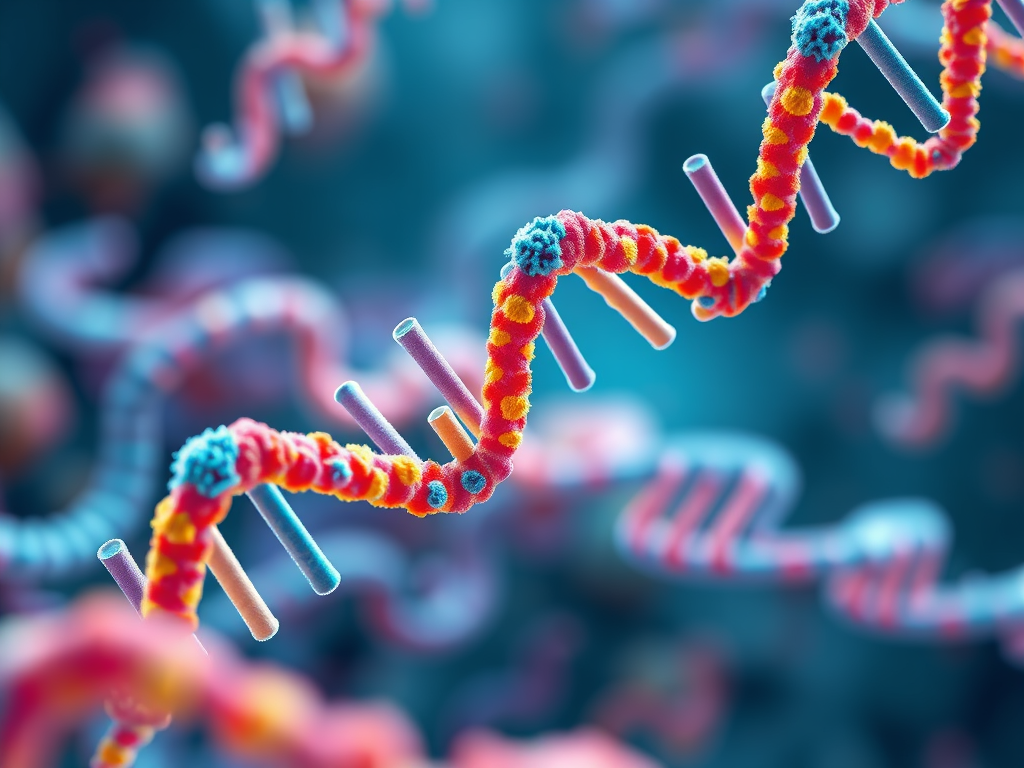
RNA Transcription
- DNA Template: RNA is synthesized using a DNA strand as a template in a process called transcription.
- RNA Polymerase: An enzyme called RNA polymerase reads the DNA sequence and creates a complementary RNA molecule.
- Base Pairing: During transcription, the DNA bases (Adenine, Thymine, Guanine, Cytosine) are paired with their complementary RNA bases (Adenine, Uracil, Guanine, Cytosine). Note that Uracil (U) in RNA replaces Thymine (T) in DNA.
- Result: The resulting RNA molecule is a single-stranded copy of the DNA sequence, with Uracil instead of Thymine.
Think of it like this:
Imagine you have a document (DNA) and you want to make a copy of a specific section (a gene). You use a photocopier (RNA polymerase) to create a copy (RNA) of that section. The copy is almost identical to the original, except for a few minor formatting changes (Uracil instead of Thymine).
Key Differences
- Sugar: DNA uses deoxyribose sugar, while RNA uses ribose sugar.
- Bases: DNA uses Adenine (A), Thymine (T), Guanine (G), and Cytosine (C). RNA uses Adenine (A), Uracil (U), Guanine (G), and Cytosine (C).
- Structure: DNA is typically double-stranded, while RNA is typically single-stranded.
- Function: DNA stores genetic information, while RNA has various roles, including carrying genetic information (mRNA), protein synthesis (tRNA, rRNA), and gene regulation.
Messenger RNA (mRNA)
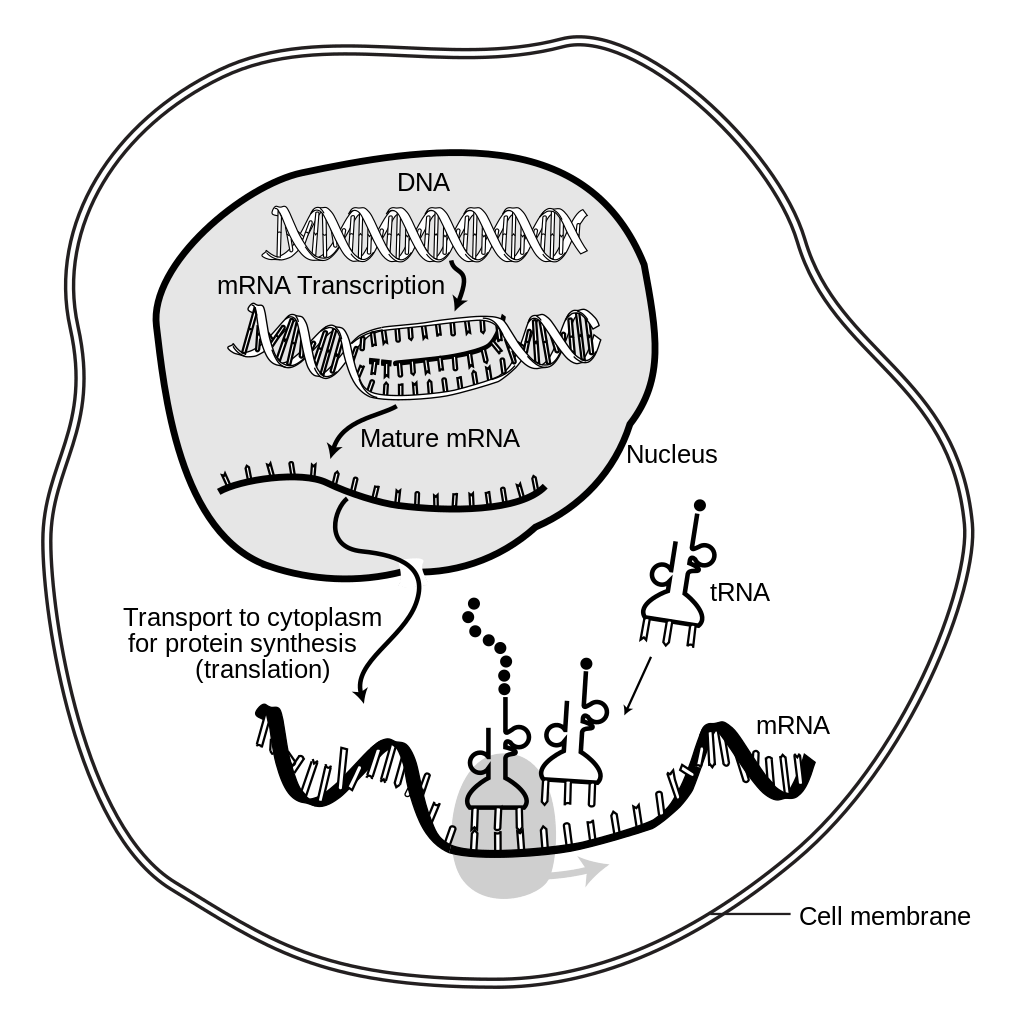
- Function: mRNA carries the genetic information from DNA in the nucleus to the ribosomes in the cytoplasm, where proteins are synthesized. It acts as a temporary copy of a gene and provides the template for protein synthesis.
- Mechanism:
- Transcription: mRNA is synthesized in the nucleus using a DNA template strand in a process called transcription. RNA polymerase enzyme reads the DNA sequence and creates a complementary mRNA molecule.
- Processing: In eukaryotes, the initial mRNA transcript (pre-mRNA) undergoes processing before it leaves the nucleus. This involves:
- Capping: A modified guanine nucleotide is added to the 5′ end of the mRNA, protecting it from degradation and aiding in ribosome binding.
- Splicing: Introns (non-coding regions) are removed, and exons (coding regions) are joined together.
- Polyadenylation: A tail of adenine nucleotides (poly-A tail) is added to the 3′ end, enhancing stability and promoting translation.
- Nuclear Export: The mature mRNA molecule is then transported out of the nucleus through nuclear pores.
- Translation: In the cytoplasm, mRNA binds to ribosomes, which read the codons (three-nucleotide sequences) on the mRNA and use them to assemble amino acids into a polypeptide chain, forming a protein.
Transfer RNA (tRNA)
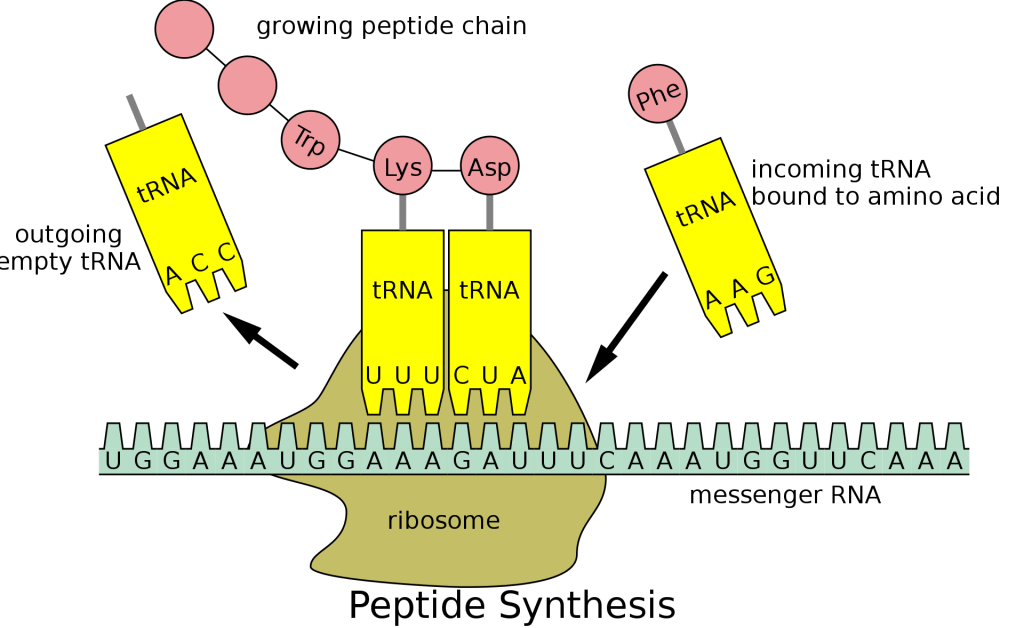
Function: tRNA acts as an adapter molecule, bringing the correct amino acid to the ribosome during protein synthesis. Each tRNA molecule is specific for a particular amino acid.
Mechanism of Protein Synthesis:
1. Amino Acid Attachment:
Definition: tRNA molecules have two key regions: an anticodon loop and an acceptor stem.
Anticodon loop: A sequence of three nucleotides that recognizes and binds to a specific codon (a sequence of three nucleotides on mRNA that codes for an amino acid or stop signal) on the mRNA through base pairing (A with U, and C with G).
Acceptor stem: The site where a specific amino acid is attached. An enzyme called aminoacyl-tRNA synthetase ensures the correct amino acid is attached to its corresponding tRNA.
2. Ribosome Binding:
Definition: tRNA molecules bind to the ribosome’s A site (aminoacyl site) if their anticodon matches the codon on the mRNA.
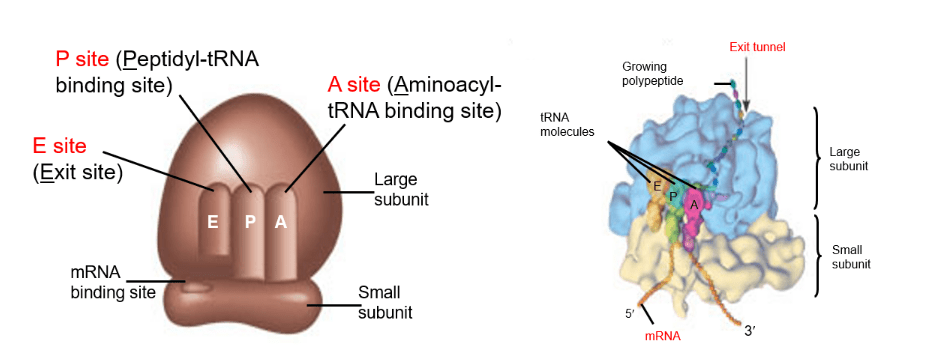
A site (aminoacyl site): The site on the ribosome where a new tRNA carrying an amino acid enters.
P site (peptidyl site): The site on the ribosome where the tRNA carrying the growing polypeptide chain is located.
E site (exit site): The site on the ribosome where the tRNA, after releasing its amino acid, exits.
How tRNA gets information that mRNA has AUG (or any other codon): tRNA molecules passively diffuse within the cell. When a tRNA with a complementary anticodon encounters a specific codon on the mRNA, it binds based on base pairing. This binding is facilitated by the ribosome, which brings the mRNA and tRNA molecules together.
3. Peptide Bond Formation:
Definition: The ribosome catalyzes the formation of a peptide bond between the amino acid carried by the tRNA in the A site and the growing polypeptide chain attached to the tRNA in the P site.
Peptide bond: A covalent bond that links two amino acids together, forming the backbone of a polypeptide chain.
4. Translocation:
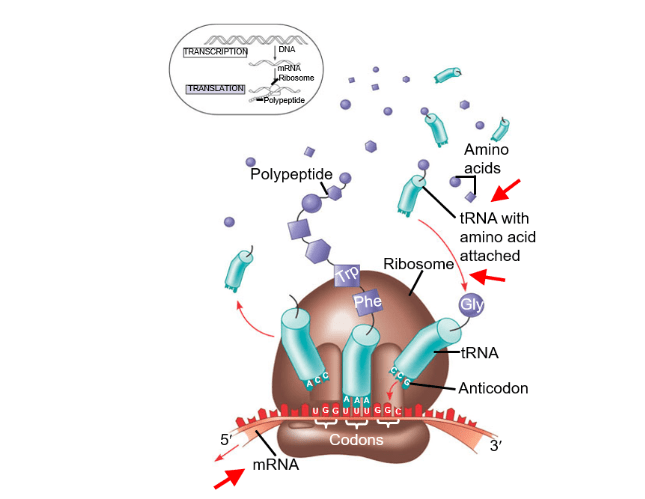
Definition: The ribosome moves along the mRNA, shifting the tRNA from the A site to the P site, and the tRNA from the P site to the E site, where it is released. This process continues until a stop codon is reached, signaling the end of protein synthesis (translation).
Ribosomal RNA (rRNA)
Ribosomes:
- Definition: Ribosomes are complex molecular machines found in all living cells. They are the primary sites of protein synthesis (translation).
- Structure: Ribosomes are composed of two subunits: a large subunit and a small subunit. Each subunit contains ribosomal RNA (rRNA) and ribosomal proteins.
- Function: Ribosomes read the genetic information encoded in messenger RNA (mRNA) and use it to assemble amino acids into polypeptide chains, which then fold to form functional proteins.
rRNA (Ribosomal RNA):
- Definition: rRNA is a type of RNA molecule that is a crucial structural and functional component of ribosomes. It makes up the majority of the ribosome’s mass.
- Structure: rRNA molecules possess complex secondary and tertiary structures that are vital for their role in protein synthesis.
- Function: rRNA molecules have multiple key functions within the ribosome:
- Structural Framework: They provide the structural scaffold for the ribosome, essentially forming its backbone.
- Binding Sites: rRNA molecules contain binding sites for mRNA and tRNA, positioning them correctly during translation.
- Catalysis: rRNA in the large ribosomal subunit directly catalyzes the formation of peptide bonds between amino acids, the fundamental step in protein synthesis.
- Translocation: rRNA assists in moving the ribosome along the mRNA molecule, allowing the next codon to be read and the next amino acid to be added to the growing polypeptide chain.
Mechanism Highlighting rRNA’s Role:
- Ribosome Assembly: rRNA molecules combine with ribosomal proteins to form the two subunits of the ribosome (large and small subunits). This assembly creates the functional protein synthesis machinery.
- mRNA Binding: The small ribosomal subunit, guided by rRNA, binds to the mRNA molecule at the start codon. This initiates the translation process.
- tRNA Binding: tRNA molecules, carrying specific amino acids, bind to the ribosome’s A and P sites, facilitated by rRNA interactions. This brings the amino acids into proximity for peptide bond formation.
- Peptide Bond Formation: rRNA in the large ribosomal subunit catalyzes the formation of peptide bonds between amino acids, linking them into a growing polypeptide chain. This is the core catalytic function of rRNA.
- Translocation: rRNA helps to move the ribosome along the mRNA, shifting the tRNA molecules from the A site to the P site, and from the P site to the E site. This exposes the next codon on the mRNA for the next tRNA to bind, continuing the protein synthesis process.
Key Differences Summarized:
| Feature | Ribosome | rRNA |
|---|---|---|
| Nature | A complex molecular machine (organelle) | A type of RNA molecule |
| Composition | rRNA and ribosomal proteins | Ribonucleotides |
| Function | Carries out protein synthesis | Structural and catalytic component of the ribosome |
Analogy:
Imagine a factory producing cars:
- Ribosome: The entire factory, where cars (proteins) are assembled.
- rRNA: The factory floor, conveyor belts, and robotic arms, providing the structure, movement, and essential tools for the assembly process.
Explanation:
- Ribosome (Factory): The ribosome is the complete system responsible for protein synthesis, analogous to a car factory that produces finished cars.
- rRNA (Floor, Belts, Arms): rRNA plays multiple roles within the ribosome, comparable to key components of the factory.
- Factory Floor (Structure): rRNA provides the structural framework for the ribosome, much like the factory floor provides the foundation for all the machinery and processes.
- Conveyor Belts (Binding & Guidance): rRNA molecules have specific binding sites for mRNA and tRNA, guiding their movement and interaction. This is similar to how conveyor belts transport parts and materials along the assembly line, ensuring they reach the right place at the right time.
- Robotic Arms (Catalysis): rRNA catalyzes the formation of peptide bonds, the crucial step in linking amino acids together. This is analogous to robotic arms performing specific tasks, like welding or fastening parts, during car assembly.
Other Regulatory RNAs
Besides mRNA, tRNA, and rRNA, there are various other types of regulatory RNAs that play important roles in gene expression and cellular processes. Here are a few examples:
- MicroRNA (miRNA): Small RNAs that bind to mRNA molecules and regulate their translation, often silencing gene expression.
- Small interfering RNA (siRNA): Similar to miRNAs, siRNAs can also silence gene expression by degrading target mRNA molecules.
- Long non-coding RNA (lncRNA): Longer RNA molecules that can regulate gene expression through various mechanisms, including chromatin remodeling and transcriptional regulation.
In summary, RNA plays diverse and essential roles in cellular function, from carrying genetic information and synthesizing proteins to regulating gene expression and maintaining cellular stability. Each type of RNA has a unique structure and function that contributes to the complexity and orchestration of life’s processes.
The Indispensable Role of RNA in Protein Synthesis
Are all proteins built by RNA?
Yes, essentially all proteins are built by RNA through a process called translation. While there are some exceptions and variations in specific organisms or cellular contexts, the vast majority of protein synthesis relies on RNA as the intermediary between DNA and proteins.
Which types of proteins are built by RNA?
All types of proteins, including structural proteins (like collagen), enzymes (like amylase), hormones (like insulin), antibodies (like IgG), and transport proteins (like hemoglobin), are built by RNA through translation.
What if RNA is not there, what will happen?
If RNA were absent, protein synthesis would grind to a halt, and the consequences would be catastrophic for the cell and the organism as a whole. Here’s a breakdown of the potential effects:
- No Protein Production: Without mRNA to carry the genetic instructions and tRNA to deliver amino acids, ribosomes wouldn’t be able to assemble proteins.
- Cellular Dysfunction: The lack of proteins would disrupt countless cellular processes, including metabolism, energy production, cell division, and signaling.
- Tissue Breakdown: Tissues would gradually break down due to the inability to repair and replace damaged proteins.
- Organ Failure: Organs would eventually fail as their protein components become depleted and dysfunctional.
- Death: Ultimately, the absence of RNA and protein synthesis would lead to the death of the organism.
In summary:
RNA is indispensable for protein synthesis, and without it, life as we know it would not be possible. The absence of RNA would have a cascading effect, leading to cellular dysfunction, tissue breakdown, organ failure, and ultimately, death.
 In the Pursuit of excellence
Leave a comment