- The Large Hadron Collider (LHC) and the Search for New Particles
- How particles are searched for in the Large Hadron Collider (LHC)
- Standard Model Vs Supersymmetry
- The Standard Model
- Supersymmetry (SUSY)
- The Big Picture: Searching Beyond the Standard Model
- Signatures of New Physics: The Clues in the Data
- Summary
- The Importance of High-Energy Collisions
- Why high energy collisions are required in particle physics
- Why This Matters for New Particle Discovery
- In a Nutshell
- Energy Transformation and Particle Formation
- Types of Particles Formed
- Examples of Particle Formation
- Summary
- The Collision Event (Imaginary Example)
- Initial State
- Interaction
- Particle Creation
- Decay
- Outgoing Particles
- Detection
- Tracking Detectors
- Calorimeters
- Muon Detectors
- Summary
- How the Mass is created in LHC
- Breakdown of the process
- How E=mc² Explains This
- Analogy
- Key Points
- Beyond the Known: Your Questions About the LHC and the Universe
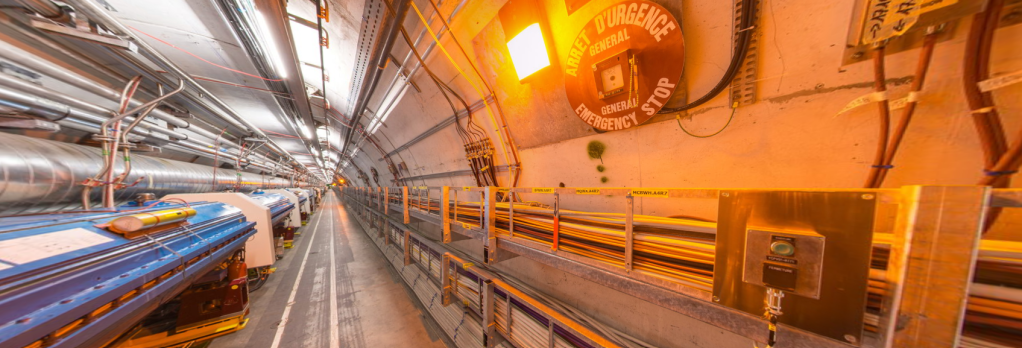
The Large Hadron Collider (LHC) and the Search for New Particles
The Large Hadron Collider (LHC) at CERN is the world’s largest and most powerful particle accelerator. Its primary purpose is to explore the fundamental building blocks of matter and the forces that govern them. One of the key goals of the LHC is to test the theory of Supersymmetry (SUSY) and potentially discover new particles, including a dark matter particle.
How particles are searched for in the Large Hadron Collider (LHC)
1. Collision and Particle Production:
- Protons are accelerated to near the speed of light in opposite directions within the LHC’s circular tunnel.
- These protons are grouped into packets, and when two packets collide, they generate a burst of energy that transforms into a variety of new particles, potentially including the ones scientists are searching for.
- The type and number of particles produced depend on the energy of the collision and the fundamental forces involved.
2. Detectors and Particle Detection:
- The collisions occur within massive detectors like ATLAS and CMS, which are designed to capture and measure the properties of the particles created in the collisions.
- These detectors consist of multiple layers, each specialized in detecting specific types of particles and their properties.
- For example, tracking detectors record the paths of charged particles, calorimeters measure their energies, and muon detectors identify muons (heavy electrons).
3. Data Collection and Analysis:
- The detectors generate vast amounts of data, recording the properties of millions of particles produced in each collision.
- This data is then processed and analyzed by sophisticated algorithms to identify potential signatures of new particles.
4. Identifying New Particles:
- Scientists search for new particles by looking for specific patterns or anomalies in the data that would indicate their presence.
- These patterns could involve unusual combinations of energy, momentum, or mass that don’t match known particles.
- For example, the Higgs Boson was discovered by observing a “bump” in the data corresponding to its predicted mass.
5. Statistical Significance:
- To confirm the discovery of a new particle, scientists require a high level of statistical significance to rule out the possibility of random fluctuations in the data.
- Typically, a “5-sigma” level of significance is required, meaning there is only a one in 3.5 million chance that the observed signal is due to random noise.
6. Confirmation and Further Studies:
- Once a new particle is discovered, scientists conduct further experiments to confirm its properties and understand its behavior.
- This might involve studying its decay products, measuring its interactions with other particles, and comparing its properties to theoretical predictions.
In summary, the LHC searches for new particles by creating high-energy collisions, detecting the particles produced, and analyzing the data for signatures of new physics. This process requires advanced detectors, sophisticated algorithms, and careful statistical analysis to identify and confirm the existence of new particles.
Standard Model Vs Supersymmetry
The Standard Model
Definition: The Standard Model is the current best theory describing the fundamental particles and forces of nature, except for gravity. It’s a quantum field theory, meaning it describes particles as excitations of underlying quantum fields.
Premises: The Standard Model is based on several key premises:
- Fundamental Particles: It describes matter as composed of fundamental particles called quarks and leptons. Quarks make up protons and neutrons, while leptons include electrons, muons, and neutrinos.
- Fundamental Forces: It describes three of the four fundamental forces:
- Strong Force: Holds quarks together to form protons and neutrons.
- Weak Force: Responsible for radioactive decay.
- Electromagnetic Force: Governs interactions between charged particles.
- Gauge Symmetry: It’s based on the principle of gauge symmetry, which dictates how particles interact with the fundamental forces.
- Quantum Field Theory: It’s formulated as a quantum field theory, where particles are described as excitations of underlying quantum fields.
Supersymmetry (SUSY)
Definition: SUSY is a theoretical extension of the Standard Model that proposes a symmetry between fundamental fermions (matter particles) and bosons (force carriers).
Differences from the Standard Model:
- New Particles: SUSY predicts the existence of a new set of particles, called superpartners, for every known particle in the Standard Model. Each fermion would have a boson superpartner, and vice versa.
- Symmetry: SUSY introduces a new symmetry, called supersymmetry, which relates fermions and bosons. This symmetry is not present in the Standard Model.
- Solving Problems: SUSY is motivated by its potential to solve some of the shortcomings of the Standard Model, such as:
- Hierarchy Problem: SUSY could explain why the Higgs boson mass is so much lighter than expected.
- Dark Matter: SUSY could provide a candidate for dark matter, the invisible substance making up a large portion of the universe’s mass.
- Grand Unification: SUSY could pave the way for a Grand Unified Theory, unifying the electroweak and strong forces.
- Experimental Evidence: While the Standard Model has been extensively verified by experiments, SUSY remains a theoretical concept with no direct experimental confirmation yet.
Summary
- The Standard Model is the current best theory describing fundamental particles and forces, except for gravity.
- SUSY is a theoretical extension of the Standard Model that proposes a symmetry between fermions and bosons, predicting new particles and potentially solving some of the Standard Model’s shortcomings.
The main difference is that SUSY introduces new particles and a new symmetry not present in the Standard Model. While the Standard Model has been extensively validated, SUSY is still a theoretical concept awaiting experimental confirmation.
The Big Picture: Searching Beyond the Standard Model
First, it’s crucial to understand the context. The Standard Model of particle physics is our current best theory for describing the fundamental building blocks of the universe and their interactions. It’s incredibly successful, having predicted the existence of particles like the Higgs boson. However, it’s known to be incomplete. It doesn’t explain:
- Dark Matter: The vast majority of the universe’s mass is made of an unknown substance that doesn’t interact with light.
- Dark Energy: An even more mysterious force that’s causing the universe’s expansion to accelerate.
- Matter-Antimatter Asymmetry: Why there’s more matter than antimatter in the universe.
- Neutrino Masses: The Standard Model initially predicted that neutrinos were massless, but experiments have shown they have a small mass.
- Gravity: The Standard Model doesn’t include gravity.
To address these shortcomings, physicists have proposed many theories that go “Beyond the Standard Model” (BSM). These theories often predict the existence of new particles and interactions. The problem is, we don’t know exactly what these new particles are or how they would behave. This is where “signatures” come in.
Signatures of New Physics: The Clues in the Data
Since we don’t know exactly what we’re looking for, physicists must be detectives, searching for unusual patterns in the data that could point toward something new. These patterns are the “signatures.”
Let’s dive into each of the signatures you mentioned:
1. Missing Energy
- What it is: In a particle collision, energy and momentum must be conserved (i.e., they have to balance). If you add up all the energy and momentum of the particles you detect after a collision, it should equal the energy and momentum of the particles that collided. If there’s a large discrepancy, with some energy and momentum seemingly “missing,” that’s a big clue.
- Why it’s a signature of new physics:
- Invisible Particles: The most likely explanation for missing energy is that one or more particles produced in the collision are invisible to our detectors. These particles would carry away energy and momentum, but we wouldn’t see them.
- Dark Matter Candidates: Many dark matter theories suggest that dark matter particles only interact very weakly with normal matter, meaning they would pass right through our detectors without being seen. Their presence would only be inferred through the missing energy signature.
- Neutrinos: Neutrinos are a Standard Model particle that interacts very weakly and often goes undetected. However, an unusual excess of missing energy could indicate other invisible particles.
- Other particles: If there are any particles which are not discovered yet, they could also be the reason for missing energy.
- How it’s detected:
- Particle Detectors: Large particle detectors, like those at the LHC, are designed to track and measure the energy and momentum of all the particles produced in collisions.
- Careful Accounting: Physicists meticulously calculate the total energy and momentum before and after each collision. Any significant difference is flagged as a potential missing energy event.
- Caveats:
- Detector Imperfections: Sometimes, particles might go undetected because they pass through parts of the detector that are less sensitive or there are gaps between detectors.
- Neutrino Background: The Standard Model already predicts a certain amount of missing energy due to neutrinos. Physicists have to carefully subtract this background to look for an excess that would indicate new physics.
2. Resonances
- What it is: A “resonance” is like a special frequency where something vibrates strongly. In particle physics, it refers to a peak or bump in the mass distribution of particles. Imagine you collect all the collisions and determine the invariant mass of the combination of particles at the end of the reaction, in the final state. For example, you measure the mass of 2 leptons, or 2 photons. If there is a peak in that distribution, it is a resonance.
- Why it’s a signature of new physics:
- New, Heavy Particles: If a new, unstable particle exists, it will quickly decay into lighter, Standard Model particles. However, it will have a characteristic mass. If you measure the mass of the decay products and add them together, there will be a peak at the original mass of the heavier particle.
- Analogous to the Higgs: The Higgs boson was discovered as a resonance in the mass distribution of photon pairs. This signature is a strong indication that the particle is real.
- New Forces/Interactions: Resonances can also be signs of new forces or interactions between particles.
- How it’s detected:
- Mass Measurement: Detectors measure the energy and momentum of the final-state particles. From these, physicists can reconstruct the “invariant mass” of the original system.
- Mass Distribution Plots: Physicists create histograms (plots) showing the distribution of these reconstructed masses. A resonance will appear as a clear peak above the background.
- Caveats:
- Statistical Fluctuations: Sometimes, random fluctuations in the data can create fake “bumps” that look like resonances. Physicists use statistics to determine if a peak is truly significant or just a coincidence.
- Background Processes: Standard Model processes can also produce bumps in mass distributions. Physicists have to carefully estimate and subtract this background.
3. Displaced Vertices
- What it is: A “vertex” is the point where particles meet or are created. In a typical collision, all the particles are created at the same point (the collision point). However, some particles might travel a measurable distance before decaying into lighter particles. When this happens, the decay point (vertex) is separated from the collision point. We call it “displaced vertex”.
- Why it’s a signature of new physics:
- Long-Lived Particles: In the Standard Model, most particles decay almost instantly. A particle that travels a noticeable distance must be relatively long-lived, meaning it decays via a weak or suppressed interaction.
- New Interactions: The existence of long-lived particles often implies new types of interactions or new quantum numbers.
- Exotic Particles: Some BSM theories predict the existence of exotic particles that could be long-lived.
- How it’s detected:
- Precise Tracking: Detectors are designed to track the paths of particles with extremely high precision.
- Vertex Reconstruction: Physicists can reconstruct the origin points (vertices) of particles based on their tracks.
- Distance Measurement: The distance between the collision point and the decay vertex is measured. A significant displacement is a sign of a long-lived particle.
- Caveats:
- Detector Resolution: If the particle’s lifetime is too short, the displacement might be too small to measure accurately, even with the best detectors.
- Background Processes: Some Standard Model particles, like b-hadrons, can travel short distances before decaying. Physicists have to be careful to distinguish these from potential BSM particles.
Summary
The “Signatures of New Physics” are the fingerprints that new particles might leave behind in the complex data from particle collisions. Physicists act as detectives, looking for these unusual patterns (missing energy, resonances, displaced vertices) to try and uncover the secrets of the universe that lie beyond our current understanding. It’s a challenging but incredibly exciting field of research!
The Importance of High-Energy Collisions
Why high energy collisions are required in particle physics
The fundamental reason high-energy collisions are essential in particle physics boils down to these key principles:
- Einstein’s E=mc²: Energy to Mass Conversion
- The Connection: Einstein’s famous equation, E=mc², states that energy (E) and mass (m) are interchangeable. The ‘c²’ is the speed of light squared, a huge number, meaning even a tiny amount of mass is equivalent to a massive amount of energy.
- In Collisions: When particles are smashed together at very high speeds, their kinetic energy (energy of motion) is converted into mass. This means new particles are created.
- Higher Energy = Heavier Particles: The higher the energy of the collision, the more mass can be created. So, to find particles that are heavier than those we already know, we need higher-energy collisions. It is similar to pushing the limit. We need more energy to push the limit.
- Probing the Early Universe: Recreating Extreme Conditions
- The Early Universe: Right after the Big Bang, the universe was incredibly hot and dense, filled with very high-energy particles.
- High-Energy Collisions as Time Machines: High-energy collisions in particle accelerators like the LHC briefly recreate these extreme conditions. It is similar to a time machine, we are going back in time and recreating the time.
- Testing Theories: By studying what happens in these collisions, we can test our fundamental theories about how the universe formed and how matter and energy interact at the most basic level. For example, we can see if the particles interact with each other in a specific way at high energies.
- Probing the Unknown: We use these high energy collisions to see how matter acts, and to look for new matter.
The Core Idea: High Energy = New Discoveries
Why This Matters for New Particle Discovery
- Standard Model Limitations: The Standard Model describes the known particles, but it’s incomplete. There must be more to the story.
- Heavier Particles: Many theories that go “Beyond the Standard Model” predict the existence of heavier, undiscovered particles (e.g., supersymmetric particles, particles that could make up dark matter).
- Need for High Energy: Finding these heavier particles requires high-energy collisions because we need enough energy to create them from scratch.
- Indirect Observation: Often, we don’t directly see the new particles. They decay rapidly into other known particles. But the high-energy collisions create them and we detect the particles that are decaying from them.
In a Nutshell
High-energy collisions are essential because they are:
- Mass Factories: They convert energy into mass, allowing us to create new, potentially heavier particles.
- Early Universe Simulators: They recreate the extreme conditions of the early universe, letting us test fundamental theories.
- New Particle Hunters: They allow us to search for new particles, and to look at how they act.
Without these high-energy collisions, we’d be stuck with only the particles we already know and would be unable to test many of our most important and fundamental theories about the universe.
Energy Transformation and Particle Formation
- Initial State: Before the collision, the two beams of protons (or heavy ions) carry immense kinetic energy due to their near-light-speed velocities.
- Collision and Energy Release: When the protons collide, their kinetic energy is released in a concentrated burst. This energy is governed by Einstein’s famous equation, E=mc², which states that energy (E) and mass (m) are interchangeable, with the speed of light (c) acting as the conversion factor.
- Energy into Mass: The released energy transforms into mass, creating a variety of new particles. This process is governed by the laws of quantum mechanics and the interactions between fundamental forces.
- Particle Formation: The specific particles formed depend on the energy of the collision and the types of interactions involved. Here’s a step-by-step breakdown:
- Quark-Gluon Plasma: In the initial moments after the collision, the extreme energy density creates a state of matter called quark-gluon plasma (QGP). This is a soup of quarks and gluons, the fundamental building blocks of protons and neutrons, that are normally confined within these particles.
- Hadronization: As the QGP cools and expands, the quarks and gluons recombine to form hadrons, which are composite particles made of quarks. These include protons, neutrons, pions, kaons, and other particles.
- Decay Cascades: Many of the particles produced are unstable and quickly decay into lighter particles. These decays can occur in a series of steps, forming a cascade of particles until stable particles like electrons, photons, and neutrinos are reached.
- Particle Detection: The detectors surrounding the collision point capture the tracks and energies of the particles, allowing physicists to identify them and reconstruct the events.
Types of Particles Formed
The particles formed in LHC collisions can be categorized into:
- Quarks: The fundamental building blocks of matter, including up, down, charm, strange, top, and bottom quarks.
- Gluons: The force carriers that bind quarks together to form hadrons.
- Leptons: Fundamental particles that do not interact strongly, including electrons, muons, taus, and their corresponding neutrinos.
- Bosons: Force carriers that mediate interactions, including photons (electromagnetism), W and Z bosons (weak force), and gluons (strong force).
- Higgs Boson: The particle responsible for giving mass to other particles.
- Beyond the Standard Model: The LHC also searches for particles beyond the Standard Model, such as supersymmetric particles, dark matter candidates, and particles predicted by theories of extra dimensions.
Examples of Particle Formation
Here are some examples of specific particle formation processes:
- Gluon Fusion: Two gluons can interact to produce a Higgs boson.
- Quark-Antiquark Annihilation: A quark and its corresponding antiquark can annihilate each other, producing a Z boson or a photon.
- Top Quark Decay: A top quark can decay into a W boson and a bottom quark.
Summary
The energy transformation in LHC collisions is a remarkable process that converts kinetic energy into mass, creating a shower of new particles. The specific particles formed depend on the collision energy and the interactions involved. By studying these particles, physicists gain insights into the fundamental building blocks of matter and the forces that govern the universe.
The Collision Event (Imaginary Example)
Initial State
Two protons, traveling in opposite directions within the LHC’s beam pipes, approach each other at velocities very close to the speed of light. Each proton carries immense kinetic energy due to its high speed.
Interaction
- Protons are not fundamental particles; they are composed of smaller constituents called quarks and gluons.
- As the protons approach each other, their internal quarks and gluons interact via the strong force, one of the four fundamental forces of nature.
- This interaction is mediated by the exchange of gluons, the force carriers of the strong force.
- The interaction is highly energetic due to the protons’ high momenta.
Particle Creation
- The immense kinetic energy carried by the colliding protons is converted into mass, creating a plethora of new particles, according to Einstein’s famous equation, E=mc².
- These new particles can include:
- Quarks and Gluons: The fundamental building blocks of matter, which can combine to form other particles.
- Photons: Particles of light, which carry electromagnetic force.
- Electrons and Muons: Fundamental particles belonging to the lepton family.
- W and Z Bosons: Force carriers of the weak nuclear force, responsible for radioactive decay.
- Higgs Bosons: Particles that give mass to other particles.
- Potentially Undiscovered Particles: Beyond the Standard Model, physicists search for new particles like supersymmetric particles or dark matter candidates.
Decay
- Many of the particles created in the collision are highly unstable and decay rapidly into lighter, more stable particles.
- For example, a top quark might decay into a W boson and a bottom quark. The W boson can then decay further into an electron and a neutrino.
- These decay chains create a cascade of particles that travel outwards from the collision point.
Outgoing Particles
- The stable decay products, such as electrons, muons, photons, and protons, along with the remnants of the original protons, continue to travel outwards from the collision point.
- These particles carry information about the original collision and the new particles that were created.
Detection
Tracking Detectors
- These detectors, typically composed of layers of silicon sensors, are designed to measure the trajectories and momenta of charged particles.
- As charged particles pass through the silicon layers, they ionize the material, creating electrical signals that are recorded.
- By reconstructing the paths of these charged particles, physicists can determine their momenta and identify the particles based on their characteristic trajectories.
Calorimeters
- These detectors measure the energies of particles by absorbing them and converting their energy into measurable signals.
- Electromagnetic calorimeters are used to measure the energies of electrons and photons.
- Hadronic calorimeters are used to measure the energies of hadrons, such as protons and neutrons.
- The energy deposited by a particle in a calorimeter is proportional to its initial energy.
Muon Detectors
- Muons are relatively heavy and long-lived charged particles. They can penetrate through the inner layers of the detector without being absorbed.
- Muon detectors are located in the outermost layers of the detector and are designed to identify and measure muons.
- These detectors typically use gas-filled chambers or scintillators to detect the passage of muons.
Summary
The collision event at the LHC is a complex and dynamic process that involves the creation and decay of numerous particles. Specialized detectors are employed to record the properties of the outgoing particles, allowing physicists to reconstruct the collision event and search for evidence of new particles. This intricate dance of particles and detectors is at the heart of the LHC’s mission to unravel the mysteries of the universe.
How the Mass is created in LHC
It’s important to note that mass is not created “out of nowhere” in the LHC collisions. Instead, the kinetic energy of the colliding protons is transformed into the mass of new particles. This transformation is a direct consequence of Einstein’s mass-energy equivalence principle, which states that energy and mass are fundamentally interchangeable.
Breakdown of the process
- Initial State: Protons are accelerated to very high speeds, gaining immense kinetic energy.
- Collision: When the protons collide, their kinetic energy is concentrated in a very small volume.
- Energy-Mass Conversion: This concentrated energy can be transformed into mass, resulting in the creation of new particles.
- Conservation of Energy: The total energy before and after the collision remains the same, but it is redistributed between the kinetic energy of the initial protons and the mass of the new particles.
How E=mc² Explains This
- Einstein’s equation, E=mc², states that energy (E) and mass (m) are equivalent and can be converted into each other.
- The speed of light (c) acts as a conversion factor, indicating the enormous amount of energy stored within even a small amount of mass.
- In the LHC collisions, the kinetic energy of the protons is the “E” in the equation. This energy is transformed into the “m” of the new particles.
Analogy
Imagine a spring compressed to store potential energy. When the spring is released, this potential energy is converted into kinetic energy, causing the spring to move. Similarly, in the LHC, the kinetic energy of the protons is like the compressed spring, and the creation of new particles is like the release of this energy into motion, but in the form of mass.
Key Points
- Mass is not created from nothing; it is transformed from energy.
- Einstein’s E=mc² provides the framework for understanding this transformation.
- The total energy of the system remains conserved.
Therefore, the creation of mass from energy in the LHC collisions is not a violation of any physical laws but rather a demonstration of the profound relationship between energy and mass.
Beyond the Known: Your Questions About the LHC and the Universe
1. Supersymmetry
- The Question: Does every known particle have a heavier, “supersymmetric” partner?
- Motivation: Supersymmetry (SUSY) is a theoretical extension of the Standard Model that introduces new particles to solve some of its shortcomings.
- LHC’s Role: If SUSY is correct, these partner particles should be produced in LHC collisions and detected by their unique signatures. Finding them would revolutionize our understanding of particle physics.
- Current Status: So far, no direct evidence of supersymmetric particles has been found at the LHC, leading to some physicists questioning the simplest SUSY models.
2. Extra Dimensions
- The Question: Are there more spatial dimensions than the three we experience?
- Motivation: String theory and other models suggest the existence of extra, hidden dimensions that could explain some fundamental mysteries.
- LHC’s Role: If extra dimensions exist, they could affect the way particles interact in LHC collisions, leading to observable effects like missing energy or the production of microscopic black holes.
- Current Status: No conclusive evidence for extra dimensions has been observed at the LHC yet.
3. Dark Matter
- The Question: What is dark matter, the invisible substance making up a large portion of the universe’s mass?
- Motivation: Astronomical observations strongly suggest the existence of dark matter, but its nature remains unknown.
- LHC’s Role: The LHC could produce dark matter particles in collisions, which would interact very weakly with detectors but could be inferred from missing energy or other signatures.
- Current Status: While the LHC has not directly detected dark matter, it has placed important constraints on the properties of dark matter particles.
4. Grand Unification
- The Question: Are the electroweak and strong nuclear forces different aspects of a single, unified force?
- Motivation: Grand Unified Theories (GUTs) propose that at very high energies, these forces merge into one.
- LHC’s Role: The LHC might find evidence for GUTs by observing rare processes predicted by these theories, such as proton decay or the production of new particles.
- Current Status: No evidence for grand unification has been found at the LHC so far.
5. Hierarchy Problem
- The Question: Why is gravity so much weaker than the other fundamental forces?
- Motivation: The vast difference in strength between gravity and the other forces is a puzzle for physicists.
- LHC’s Role: Some theories, like SUSY or extra dimensions, could explain this hierarchy. Finding evidence for these theories at the LHC would address the hierarchy problem.
- Current Status: The hierarchy problem remains a major open question in physics, with the LHC providing some constraints but no definitive solutions yet.
6. Quark Flavour Mixing
- The Question: Are there more ways for quarks to change their “flavor” than we currently know?
- Motivation: The Standard Model describes how quarks can change flavor, but there might be additional sources of flavor mixing.
- LHC’s Role: The LHC can search for these new sources by studying rare decays of particles containing heavy quarks.
- Current Status: The LHC has made precise measurements of quark flavor mixing, but no significant deviations from the Standard Model have been observed.
7. Matter-Antimatter Asymmetry
- The Question: Why is there more matter than antimatter in the universe?
- Motivation: The Big Bang should have created equal amounts of matter and antimatter, but we observe a universe dominated by matter.
- LHC’s Role: The LHC can study the properties of particles and antiparticles to look for subtle differences that could explain this asymmetry.
- Current Status: The LHC has made important contributions to understanding CP violation, a phenomenon related to matter-antimatter asymmetry, but the full explanation remains a mystery.
In summary, the LHC is a powerful tool for exploring fundamental open questions in physics. While many questions remain unanswered, the LHC continues to provide valuable data and insights, pushing the boundaries of our understanding of the universe.
 In the Pursuit of excellence
Leave a comment