Table of Contents
- Unraveling the “Microwave” Mystery in the Cosmic Microwave Background
- Photons: The Building Blocks of Light
- The Dual Nature of Light: Waves and Particles
- The Importance of Photons in Light
- A Journey Back in Time
- The Cosmic Stretch: Redshift in Action
- From Visible Light to Microwaves
- The Blackbody Spectrum and the Peak
- A Window to the Early Universe
- Unraveling the Redshifts: Distinguishing Cosmological and Doppler Effects
- Cosmological Redshift
- Doppler Redshift
- Subtle Difference
- Differentiating Between Cosmological and Doppler Redshift
- Distance
- Spectrum
- Context
- Magnitude
- Other Effects
- Recombination Epoch and Photons
- Cosmological Redshift’s Impact
- Where Does the Energy Go? Exploring Energy Conservation in an Expanding Universe
- Energy Conservation and Expansion
- Where did the energy go?
- Analogy
- In the context of cosmological redshift
- Important Considerations
- Summary
- The Stretching of Light: How Photons Respond to Expanding Spacetime
- Spacetime as a Framework
- General Relativity and Light’s Path
- Stretching Spacetime and Wavelength
- Why photons stretch?
- Evidence for Stretching
- Hypothetical Nature of Spacetime Fabric
- Spacetime as a Framework
- Summary
Unraveling the “Microwave” Mystery in the Cosmic Microwave Background
The Cosmic Microwave Background (CMB) is a faint, relic radiation that permeates the entire universe. It’s a fascinating echo of the early universe, providing valuable insights into its origins and evolution. But have you ever wondered why it’s called “microwave”? The answer lies in a captivating tale of cosmic expansion and the stretching of light, and to understand it fully, we first need to delve into the nature of light itself.
Photons: The Building Blocks of Light
Light, the very essence that allows us to perceive the universe, is made up of tiny packets of energy called photons. These fundamental particles have no mass and travel at the speed of light, the ultimate speed limit in the cosmos.
The Dual Nature of Light: Waves and Particles
Light exhibits a fascinating duality: it can behave as both a wave and a particle. This wave-particle duality is a fundamental concept in physics.
- Wave-like behavior: Light exhibits wave-like properties such as interference and diffraction, bending around obstacles and creating patterns of bright and dark regions.
- Particle-like behavior: Light also behaves like a stream of particles, interacting with matter in discrete packets of energy. This is evident in phenomena like the photoelectric effect, where light knocks electrons off a metal surface.
The Importance of Photons in Light
Photons play a crucial role in understanding the nature of light and its interactions with matter. They are the carriers of electromagnetic energy, including visible light, radio waves, microwaves, and X-rays. The energy of a photon is directly related to its frequency (or wavelength): higher frequency photons have more energy.
In the context of the CMB, photons are the messengers that carry information about the early universe. They were released during recombination when the universe cooled enough for protons and electrons to combine into neutral atoms, allowing light to travel freely.
A Journey Back in Time
To understand the “microwave” connection, we need to rewind the cosmic clock to a period known as recombination, about 380,000 years after the Big Bang. Before this era, the universe was a hot, dense soup of particles, including protons, electrons, and photons. Light couldn’t travel freely; it constantly scattered off these charged particles, creating a foggy and opaque universe.
As the universe expanded and cooled, a pivotal moment arrived. Protons and electrons combined to form neutral hydrogen atoms, allowing photons to finally escape and travel unimpeded. This “first light” is what we observe today as the CMB.
The Cosmic Stretch: Redshift in Action
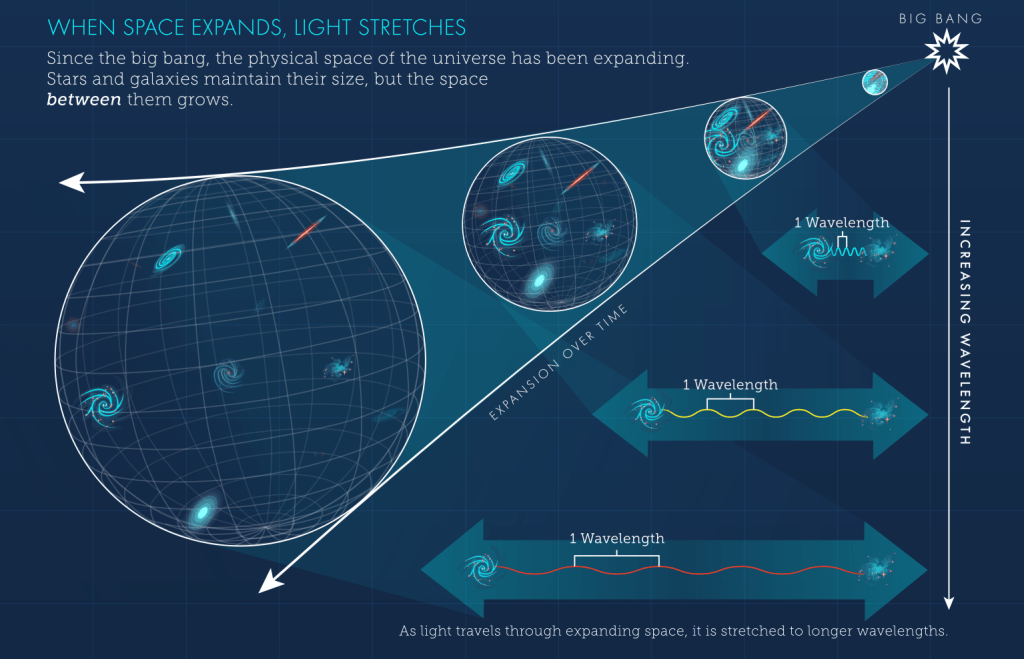
However, the light from recombination didn’t remain unchanged. The universe continued to expand, stretching the fabric of space-time itself. As light waves traveled through this expanding space, their wavelengths also stretched, shifting towards the lower-energy, longer-wavelength end of the electromagnetic spectrum. This phenomenon is known as redshift.
Imagine a wave on a rope. As you stretch the rope, the distance between the wave crests increases, resulting in a longer wavelength. Similarly, the expansion of the universe stretched the wavelengths of the CMB photons, causing their energy to decrease.
From Visible Light to Microwaves
Initially, the photons released during recombination were energetic enough to be visible light or even higher-energy radiation. But over billions of years of cosmic expansion, their wavelengths have been stretched significantly.
The CMB radiation we observe today has a peak wavelength of around 1.9 millimeters, which falls squarely within the microwave region of the electromagnetic spectrum. This is why it’s called the “Cosmic Microwave Background.”
The Blackbody Spectrum and the Peak
The CMB radiation follows a blackbody spectrum, meaning it emits radiation at all wavelengths with a specific distribution determined by its temperature. The peak of this spectrum, where the radiation is most intense, has shifted into the microwave region due to the redshift caused by the universe’s expansion.
A Window to the Early Universe
The “microwave” in the CMB is not just a name; it’s a direct consequence of the universe’s evolution. By studying this relic radiation, we gain invaluable insights into the conditions of the early universe, its composition, and the processes that shaped its structure.
So, the next time you hear about the Cosmic Microwave Background, remember the incredible journey of light stretching across vast cosmic distances, transforming from visible light into microwaves, and carrying with it the secrets of the early universe. It’s a testament to the power of science to unravel the mysteries of our cosmos.
Unraveling the Redshifts: Distinguishing Cosmological and Doppler Effects
Cosmological Redshift
- Definition: Cosmological redshift is the stretching of light wavelengths as photons travel through the expanding universe.
- Cause: It’s caused by the expansion of space itself, not the motion of the object emitting the light.
- Analogy: Imagine dots on a balloon that’s being inflated. As the balloon expands, the dots move farther apart, and the light traveling between them gets stretched.
- Implication: It’s the primary evidence for the expansion of the universe and is used to determine distances to faraway galaxies.
Doppler Redshift
- Definition: Doppler redshift is the stretching of light wavelengths due to the relative motion of the light source and the observer.
- Cause: It’s caused by the Doppler effect, where wavelengths are stretched if the source is moving away and compressed if it’s moving closer.
- Analogy: Think of the sound of a siren changing pitch as an ambulance approaches and then moves away.
- Implication: It’s used to measure the velocities of stars and galaxies within our local group.
Subtle Difference
The key difference lies in the cause of the redshift:
- Cosmological redshift is due to the expansion of space itself. The photons are stretched as they travel through expanding space.
- Doppler redshift is due to the relative motion between the light source and the observer. The photons are stretched or compressed due to the Doppler effect.
In simpler terms:
- Cosmological redshift happens because the universe is expanding, like the dots on an inflating balloon.
- Doppler redshift happens because the object emitting light is moving away from us, like a receding ambulance siren.
While both redshifts result in the stretching of light wavelengths, their underlying causes are distinct. Cosmological redshift is a fundamental property of the expanding universe, while Doppler redshift is a consequence of relative motion within that universe.
Differentiating Between Cosmological and Doppler Redshift
While both cosmological and Doppler redshift result in the stretching of light wavelengths, there are ways to distinguish between them:
Distance
- Cosmological redshift: Primarily affects light from distant galaxies, as the expansion of space has a more significant impact over larger distances.
- Doppler redshift: More noticeable for objects within our local group, such as stars and nearby galaxies, where relative velocities are more significant.
Spectrum
- Cosmological redshift: Stretches all wavelengths of light uniformly, maintaining the overall shape of the spectrum.
- Doppler redshift: Affects wavelengths differently depending on the object’s velocity, potentially distorting the spectrum’s shape.
Context
- Cosmological redshift: Used to study the expansion of the universe and determine distances to faraway galaxies.
- Doppler redshift: Used to measure the velocities of stars and galaxies within our local group and study their dynamics.
Magnitude
- Cosmological redshift: Can be very large, especially for objects at high redshifts (z > 1), indicating significant expansion of the universe since the light was emitted.
- Doppler redshift: Typically smaller, reflecting the relative velocities of objects within our local group.
Other Effects
- Cosmological redshift: Can be affected by gravitational lensing, where light is bent by massive objects, potentially altering the observed redshift.
- Doppler redshift: Can be influenced by the rotation of galaxies, causing a broadening of spectral lines.
In Practice:
Astronomers often use a combination of these factors to determine whether a redshift is primarily cosmological or Doppler in origin. They consider the object’s distance, the shape of its spectrum, the context of the observation, and other relevant factors to make a determination.
In simpler terms:
- If the object is very far away and its spectrum is uniformly stretched, the redshift is likely cosmological.
- If the object is relatively nearby and its spectrum shows distortions or broadening, the redshift is likely Doppler.
Example:
- The redshift of a distant quasar is primarily cosmological, indicating its distance and the expansion of the universe.
- The redshift of a star in our galaxy is primarily Doppler, reflecting its motion relative to us.
By carefully considering these factors, astronomers can differentiate between cosmological and Doppler redshift and gain valuable insights into the nature of the universe and its constituents.
Recombination Epoch and Photons
The recombination epoch was a period in the early universe, about 378,000 years after the Big Bang, when protons and electrons combined to form neutral hydrogen atoms. Before this epoch, the universe was a hot, dense plasma of charged particles, opaque to light. After recombination, the universe became transparent, allowing photons to travel freely. These photons, initially released as high-energy radiation, form the Cosmic Microwave Background (CMB) that we observe today.
Cosmological Redshift’s Impact
As these CMB photons traveled through the expanding universe, they experienced cosmological redshift. Here’s how it affected them:
- Energy Loss: Yes, the photons did lose energy. As the universe expanded, the wavelengths of the photons stretched, causing their energy to decrease. This is because the energy of a photon is inversely proportional to its wavelength:
E = hc / λ
where: * E is the energy of the photon * h is Planck’s constant * c is the speed of light * λ is the wavelength of the photon - Wavelength Change: The wavelength of the CMB photons increased significantly due to cosmological redshift. The amount of redshift is denoted by ‘z’, and it’s related to the change in wavelength by:
1 + z = λ_observed / λ_emitted
where: * λ_observed is the observed wavelength of the photon today * λ_emitted is the wavelength of the photon when it was emitted during recombination - Quantifying the Change: The CMB photons were initially emitted with wavelengths in the ultraviolet and visible range. Due to cosmological redshift, their wavelengths have been stretched by a factor of about 1100, shifting them into the microwave region of the electromagnetic spectrum. This corresponds to a redshift of z ≈ 1100.
- In essence, cosmological redshift caused the photons from the recombination epoch to lose energy and have their wavelengths stretched significantly. This is why we observe the CMB today as microwave radiation, even though it was initially emitted as much higher-energy light. This redshift is a key piece of evidence supporting the Big Bang theory and the expansion of the universe.
Where Does the Energy Go? Exploring Energy Conservation in an Expanding Universe
Energy Conservation and Expansion
The key to understanding this lies in the nature of cosmological redshift and the expansion of the universe. It’s not that photons are losing energy to the vacuum or any other medium. Instead, their energy decrease is intrinsically linked to the stretching of space itself.
Think of it this way:
- As the universe expands, the fabric of spacetime stretches.
- Photons traveling through this expanding space have their wavelengths stretched along with it.
- This stretching of the wavelength corresponds to a decrease in the photon’s energy.
Where did the energy go?
The energy isn’t lost or dissipated in the traditional sense. It’s more accurate to say that the energy density of the photons has decreased as the universe has expanded. The total energy of the photons is diluted over a larger volume of space.
Analogy
Imagine a guitar string being stretched. As the string stretches, the wavelength of the vibrations on the string increases, leading to a lower frequency and lower energy. The energy of the vibration isn’t lost; it’s simply distributed over a larger length of the string.
In the context of cosmological redshift
- The “stretching” is due to the expansion of space.
- The “guitar string” is the fabric of spacetime.
- The “vibrations” are the photons traveling through space.
Important Considerations
- No Interaction: Photons don’t interact with the vacuum of space in a way that would cause them to lose energy through traditional processes like scattering or absorption.
- Energy Density: The energy density of the universe decreases as it expands. This decrease is not just due to the redshift of photons but also applies to other forms of energy, like matter and dark energy.
- Conservation Laws: While energy density decreases, the total energy within a comoving volume of the universe remains constant. This is in accordance with the principle of energy conservation in general relativity.
In Summary
Photons from the recombination epoch lost energy due to cosmological redshift. This energy loss is not due to interaction with the vacuum or any other medium but is a consequence of the stretching of spacetime itself as the universe expands. The energy is diluted over a larger volume, leading to a decrease in energy density while maintaining overall energy conservation.
The Stretching of Light: How Photons Respond to Expanding Spacetime
Spacetime as a Framework
While the concept of a “spacetime fabric” is indeed a metaphorical representation, it helps us visualize how gravity and the expansion of the universe affect the motion of objects and light.
General Relativity and Light’s Path
In Einstein’s theory of general relativity, gravity is not a force but a curvature of spacetime caused by mass and energy. This curvature influences the paths of objects and even light. Light follows geodesics, which are the shortest paths through spacetime.
Stretching Spacetime and Wavelength
When the universe expands, it’s not just the distance between galaxies that increases; the fabric of spacetime itself stretches. This stretching affects the paths of photons traveling through space.
Think of it this way:
- Imagine a photon emitted from a distant galaxy billions of years ago.
- As this photon travels towards us, the space it traverses expands.
- This expansion stretches the photon’s wavelength, causing it to redshift.
Why photons stretch?
Photons are inherently wave-like. They are electromagnetic waves that propagate through spacetime. When the spacetime through which they travel expands, the wave itself is stretched along with it. This stretching is analogous to the stretching of a wave on a string when the string is lengthened.
Evidence for Stretching
The observed redshift of light from distant galaxies is strong evidence that photons stretch as the universe expands. The farther away a galaxy is, the more its light has been redshifted, indicating that the photons have traveled through more expanding space.
Hypothetical Nature of Spacetime Fabric
While the “fabric” analogy is helpful for visualization, the underlying principle is the curvature of spacetime described by general relativity. This curvature dictates how light propagates and how its wavelength changes as it travels through expanding space.
In essence, photons stretch because they are waves that propagate through spacetime, and the expansion of the universe stretches the spacetime itself. This stretching alters the photon’s wavelength, causing it to redshift. While the “fabric” analogy is a simplification, it conveys the fundamental idea that photons are affected by the geometry of spacetime.
Additional points to consider:
- No Medium Required: This stretching doesn’t require a medium like air or water. It’s a consequence of the inherent properties of spacetime and electromagnetic waves.
- Redshift is Proportional to Distance: The amount of redshift is proportional to the distance the photon has traveled, which is consistent with an expanding universe.
- Cosmological Redshift vs. Doppler Redshift: While both effects cause redshift, cosmological redshift is due to the expansion of space itself, not the relative motion of objects.
Summary
In this blog post, I’ve explored the intriguing question of why we call the Cosmic Microwave Background (CMB) “microwave.” We started by delving into the fascinating world of light, understanding photons as its fundamental particles and acknowledging its dual nature as both a wave and a particle. Then, we embarked on a journey back in time to the early universe, witnessing how the expansion of space stretched the light emitted during the Big Bang – a phenomenon known as redshift. This stretching shifted the light’s energy from visible wavelengths to the microwave region of the electromagnetic spectrum.
And that’s why we call it the Cosmic Microwave Background! It’s a faint afterglow of the Big Bang, now peaking in the microwave range. This cosmic echo provides a unique window into the early universe, allowing us to probe its conditions and evolution.
The “Microwave” Significance:
The term “microwave” in the CMB isn’t just a label; it’s a profound reminder of the universe’s journey and our ability to understand it. It highlights how the expansion of space has transformed light over vast cosmic timescales, leaving behind a subtle but crucial signal for us to decipher. This microwave radiation, once visible light, carries the secrets of the early universe, helping us piece together the story of our cosmic origins. It’s a testament to the interconnectedness of light, time, and the expansion of space, a cosmic symphony playing out across billions of years.
By embracing the “microwave” in the Cosmic Microwave Background, we embrace a deeper understanding of our universe and our place within it.
 In the Pursuit of excellence
Leave a comment