Table of Contents
- The Gunn-Peterson Effect: Unveiling the Intergalactic Medium
- The Mechanism
- Observations and Interpretations
- Quasars: Beacons from the Edge of Time
- Quasars: Beacons of Extreme Luminosity and Distance
- Why Not Other Stars?
- The Lyman-alpha Forest: A Fingerprint of Neutral Hydrogen
- The Intergalactic Medium (IGM): A Cosmic Web
- What is Lyman-alpha Forest ?
- Decoding the Lyman-alpha Forest
- Significance in Understanding the Universe
- Wavelengths and Their Meaning
- Conclusion: A Window to the Cosmic Dawn
The universe, in its vastness and complexity, holds secrets that have captivated astronomers for centuries. Among these enigmatic phenomena is the Gunn-Peterson effect, a subtle but powerful tool that allows us to peer into the distant past and unravel the mysteries of the early universe.
The Gunn-Peterson Effect: Unveiling the Intergalactic Medium
In 1965, James Gunn and Bruce Peterson predicted a fascinating effect that would become a cornerstone of cosmological research. They theorized that light from distant quasars would be absorbed by neutral hydrogen gas present in the intergalactic medium (IGM), the vast expanse of space between galaxies.
The Mechanism
- Quasar Emission: Quasars emit light across a broad spectrum, including UV photons with energies higher than the Lyman-alpha transition energy of 10.2 eV.
- Redshifting: As these UV photons traverse the expanding universe, their wavelengths are stretched due to redshift.
- Absorption: When the energy of a redshifted photon matches the 10.2 eV energy of the Lyman-alpha transition in neutral hydrogen, it is absorbed by the hydrogen atoms in the IGM.
- Expected Observation: Initially, it was anticipated that the quasar’s spectrum would exhibit a sharp cutoff at wavelengths shorter than the redshifted Lyman-alpha line, indicating complete absorption of these photons by neutral hydrogen. This cutoff was expected to be a “cliff” in the spectrum.
Observations and Interpretations
However, observations of distant quasars revealed a more nuanced picture. Instead of a sharp cutoff, the spectrum appeared “chopped up” or displayed a “termite-attacked” appearance. This indicated that the absorption by neutral hydrogen was not complete but rather patchy or incomplete.
Quasars: Beacons from the Edge of Time
Quasars, short for “quasi-stellar radio sources,” are celestial objects of immense luminosity and distance. They reside at the centers of galaxies, fueled by supermassive black holes that devour surrounding matter and unleash torrents of energy across the electromagnetic spectrum. This energy includes ultraviolet (UV) radiation, crucial to understanding the Gunn-Peterson effect.
Quasars: Beacons of Extreme Luminosity and Distance
Quasars possess several unique characteristics that make them ideal for observing the Gunn-Peterson effect:
- Extreme Luminosity: Quasars are incredibly luminous, outshining entire galaxies. This extreme brightness ensures that their light can travel vast cosmic distances and still be detectable by telescopes on Earth. This is crucial for observing the Gunn-Peterson effect, as it requires light to traverse significant portions of the intergalactic medium (IGM) where neutral hydrogen absorption occurs.
- Distant Location: Quasars are typically located at very large distances from us, corresponding to early epochs in the universe’s history. This is important because the Gunn-Peterson effect is most prominent in the early universe when the IGM contained a higher fraction of neutral hydrogen. The light from distant quasars has traveled through this early IGM, providing a glimpse into its properties and conditions.
- Ultraviolet Emission: Quasars emit strongly in the ultraviolet (UV) portion of the electromagnetic spectrum. This is significant because the Lyman-alpha transition of neutral hydrogen, which is responsible for the absorption in the Gunn-Peterson effect, occurs in the UV range. Therefore, the UV emission from quasars provides ample photons for absorption by neutral hydrogen in the IGM.
Why Not Other Stars?
While other stars also emit light, they generally lack the combination of extreme luminosity, distance, and UV emission that makes quasars ideal for observing the Gunn-Peterson effect.
- Lower Luminosity: Most stars are significantly less luminous than quasars. Their light is not as intense and may not be detectable after traveling vast cosmic distances. This limits the ability to observe absorption by neutral hydrogen in the IGM.
- Closer Proximity: Stars within our galaxy or nearby galaxies are relatively close to us. Their light has not traveled through as much of the IGM, reducing the chances of encountering significant amounts of neutral hydrogen for absorption.
- Limited UV Emission: While stars do emit some UV radiation, it is often not as intense as the UV emission from quasars. This reduces the number of photons available for absorption by neutral hydrogen in the IGM.
The unique combination of extreme luminosity, distant location, and strong UV emission makes quasars ideal for observing the Gunn-Peterson effect. These properties ensure that their light can travel vast distances, probe the early universe when neutral hydrogen was more abundant, and provide ample photons for absorption by neutral hydrogen in the IGM.
The Lyman-alpha Forest: A Fingerprint of Neutral Hydrogen
The Intergalactic Medium (IGM): A Cosmic Web
The intergalactic medium (IGM) is the vast expanse of space between galaxies, comprising mostly of ionized hydrogen gas with traces of heavier elements. This diffuse gas plays a crucial role in the evolution of the universe, acting as a reservoir of material for galaxy formation and influencing the propagation of light from distant objects.
What is Lyman-alpha Forest ?
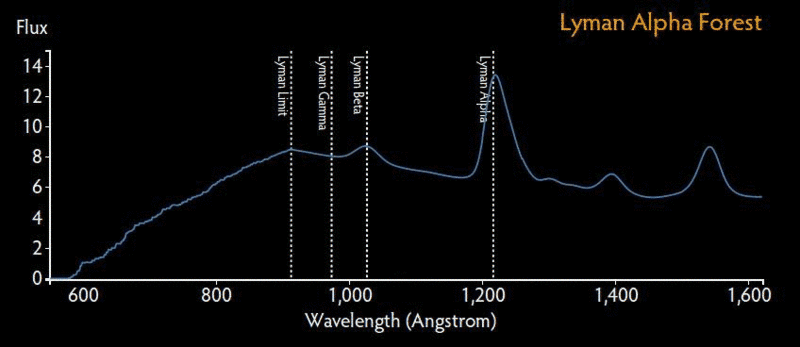
As light from a distant quasar travels through the IGM, it encounters pockets of neutral hydrogen gas. These neutral hydrogen atoms can absorb photons with specific energies, corresponding to the Lyman-alpha transition. This absorption creates a series of absorption lines in the quasar’s spectrum, known as the Lyman-alpha forest.
Hydrogen, the most abundant element in the universe, possesses a unique spectral signature known as the Lyman-alpha line. This line is emitted when an electron within a hydrogen atom transitions from a higher energy level to the ground state, releasing a photon with a specific wavelength of 121.6 nanometers (nm) or an energy of 10.2 electron volts (eV).
Decoding the Lyman-alpha Forest
- Redshift and Distance: The redshift of each absorption line in the Lyman-alpha forest corresponds to the distance of the intervening neutral hydrogen cloud from us. By analyzing the redshifts of these lines, astronomers can map the distribution of neutral hydrogen along the quasar’s line of sight, effectively creating a 3D map of the IGM.
- Density and Temperature: The strength and width of the absorption lines provide information about the density and temperature of the neutral hydrogen clouds. Denser and colder clouds produce stronger and broader absorption lines, while less dense and warmer clouds produce weaker and narrower lines. This allows astronomers to study the physical properties of the IGM.
- Epoch of Reionization: The presence and strength of the Gunn-Peterson trough, a prominent feature in the Lyman-alpha forest, are crucial for understanding the Epoch of Reionization. This epoch marked the transition of the universe from a neutral state to an ionized state, as the first stars and galaxies emitted ionizing radiation that gradually transformed the IGM. The Gunn-Peterson trough provides a “snapshot” of the reionization process, allowing astronomers to determine when and how it occurred.
- Large-Scale Structure: The distribution of neutral hydrogen clouds revealed by the Lyman-alpha forest reflects the large-scale structure of the universe, including filaments, voids, and galaxy clusters. This information helps astronomers understand the formation and evolution of these cosmic structures.
- Early Universe Conditions: By studying the Lyman-alpha forest in the spectra of very distant quasars, astronomers can probe the conditions of the IGM at early times, shortly after the Big Bang. This provides valuable insights into the early universe and its evolution.
The absorption of quasar light by neutral hydrogen gas in the IGM acts as a powerful probe of the universe’s structure, evolution, and early conditions. The Lyman-alpha forest serves as a cosmic fingerprint, revealing the distribution, properties, and history of the intergalactic medium, and ultimately contributing to our understanding of the universe as a whole.
Significance in Understanding the Universe
The Lyman-alpha forest provides crucial insights into the distribution, properties, and evolution of the IGM, which is the vast expanse of space between galaxies. It allows astronomers to:
- Map the Distribution of Neutral Hydrogen: By analyzing the redshifts of the absorption lines, astronomers can pinpoint the location and density of neutral hydrogen clouds along the quasar’s line of sight. This creates a 3D map of the IGM, revealing its structure and evolution over cosmic time.
- Probe the Epoch of Reionization: The presence and strength of the Gunn-Peterson trough, a prominent feature in the Lyman-alpha forest, are crucial for understanding the Epoch of Reionization, a period when the universe transitioned from a neutral state to an ionized state. This epoch marked the formation of the first stars and galaxies, which emitted ionizing radiation that gradually transformed the IGM.
- Study the Physical Properties of the IGM: The strength and width of the absorption lines provide information about the density, temperature, and ionization state of the neutral hydrogen clouds. This allows astronomers to study the physical properties of the IGM and its evolution.
- Understand the Large-Scale Structure of the Universe: The distribution of neutral hydrogen clouds revealed by the Lyman-alpha forest reflects the large-scale structure of the universe, including filaments, voids, and galaxy clusters. This information helps astronomers understand the formation and evolution of these cosmic structures.
Wavelengths and Their Meaning
Each absorption line in the Lyman-alpha forest corresponds to a specific wavelength of light absorbed by neutral hydrogen atoms. The redshift of the line indicates the distance of the intervening neutral hydrogen cloud from us. By analyzing the redshifts and wavelengths of the lines, astronomers can:
- Determine the Distance to the Absorbing Clouds: The redshift of an absorption line is directly related to the distance of the absorbing cloud. Higher redshifts indicate greater distances, allowing astronomers to probe the IGM at different epochs in the universe’s history.
- Estimate the Density of Neutral Hydrogen: The strength of an absorption line is proportional to the density of neutral hydrogen in the absorbing cloud. By measuring the line strength, astronomers can estimate the density of the IGM at different locations and times.
- Infer the Temperature of the IGM: The width of an absorption line is related to the temperature of the absorbing cloud. Broader lines indicate higher temperatures, while narrower lines indicate lower temperatures. This allows astronomers to probe the thermal properties of the IGM.
The Lyman-alpha forest is a powerful tool for studying the IGM and its evolution. By analyzing the redshifts, wavelengths, and strengths of the absorption lines, astronomers can map the distribution of neutral hydrogen, probe the Epoch of Reionization, study the physical properties of the IGM, and understand the large-scale structure of the universe.
Conclusion: A Window to the Cosmic Dawn
The Gunn-Peterson effect, a seemingly subtle phenomenon of light absorption, has opened a remarkable window into the early universe and the vast expanse of the intergalactic medium (IGM). By studying the spectra of distant quasars, these beacons from the edge of time, astronomers have been able to unravel crucial aspects of cosmic evolution.
The Lyman-alpha forest, a distinctive pattern of absorption lines in quasar spectra, serves as a cosmic fingerprint of neutral hydrogen in the IGM. Decoding this fingerprint has allowed us to map the distribution of this fundamental element, probe the Epoch of Reionization, and understand the physical properties and large-scale structure of the IGM.
Quasars, with their extreme luminosity and distant locations, are uniquely suited to this task. Their light has traversed vast cosmic distances, encountering neutral hydrogen along the way and revealing its presence through the Gunn-Peterson effect. While other stars emit light, they lack the combination of extreme brightness, distance, and UV emission that makes quasars such powerful probes of the early universe.
The observations and interpretations of the Gunn-Peterson effect and the Lyman-alpha forest have provided invaluable insights into the early universe, allowing us to glimpse the conditions shortly after the Big Bang and witness the transformation of the IGM from a neutral state to an ionized one.
As we continue to explore the cosmos, the Gunn-Peterson effect will remain a vital tool for understanding the structure, evolution, and ultimate fate of the universe. It is a testament to the ingenuity of astronomers and their relentless pursuit of knowledge, guiding us toward a deeper understanding of the cosmic dawn and the intricate tapestry of the universe.
This journey into the realm of the Gunn-Peterson effect has illuminated the vastness and complexity of the cosmos, reminding us of the profound mysteries that continue to inspire awe and wonder.
 In the Pursuit of excellence
Leave a comment