Table of Content
- What are Quasars?
- Types of Active Galactic Nuclei (AGN)
- Types of Quasars
- Does every black hole have a quasar?
- How large are quasars?
- How far away are quasars?
- How are Quasars Formed?
- Triggering Quasar Activity
- Quasar Life Cycle
- How do Quasars Appear?
- Visual Appearance
- Spectral Appearance
- Radio and X-ray Appearance
- Host Galaxy Appearance
- Observational Challenges
- How are Quasars Classified?
- Radio-Loud vs. Radio-Quiet Quasars
- Spectral Classification
- Luminosity Classification
- Variability Classification
- Other Classification Schemes
- How were Quasars Discovered?
- How are Quasars Explained?
- Theoretical Framework
- Observational Evidence
- Simulations and Models
- Open Questions and Future Research Directions
- How are Quasars Studied?
- Observational Techniques
- Theoretical Techniques
- Space Missions and Surveys
- Collaborations and Databases
- How are Quasars Related to Galaxy Mergers?
- Process Unfolding
- Evidence for the Connection
- Significance
- Conclusion: Unraveling the Mysteries of Quasars
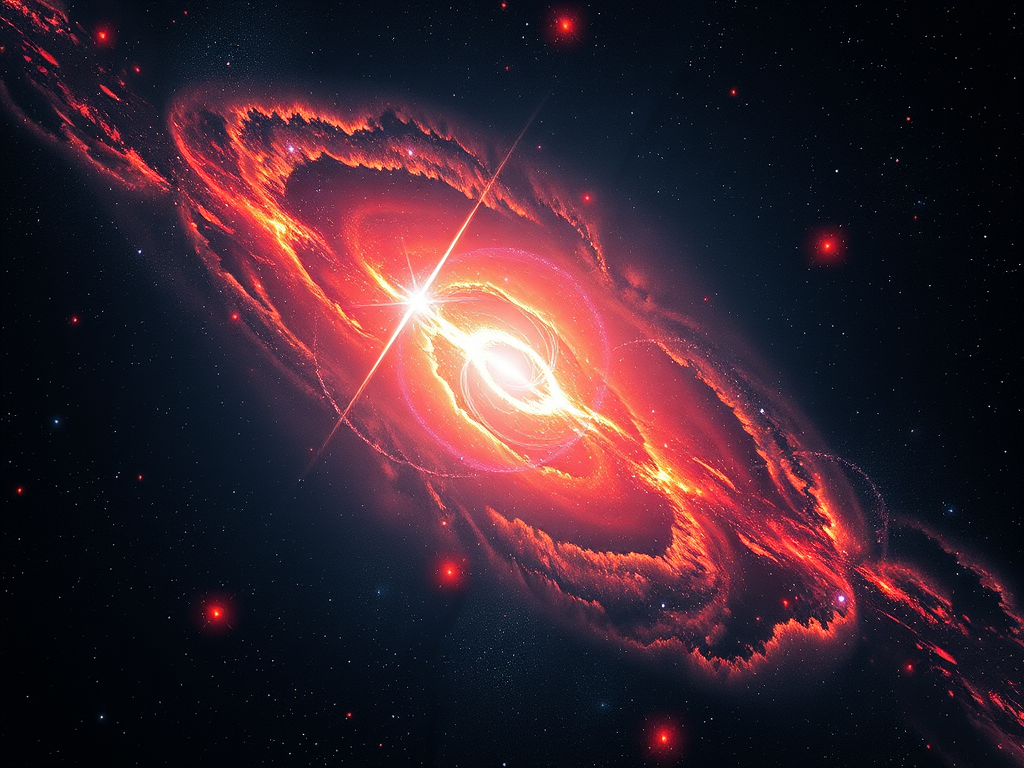
Quasars (Quasi-Stellar Radio Sources) are incredibly luminous objects in the universe, believed to be powered by supermassive black holes at the centers of galaxies. They are among the brightest objects in the universe, outshining entire galaxies and emitting massive amounts of energy across the entire electromagnetic spectrum.
Characteristics of Quasar
- Polarization: Quasar light is often polarized, indicating that it has passed through a strong magnetic field or has been scattered by hot electrons.
- Extreme luminosity: Quasars are incredibly bright, with luminosities that can exceed 10^40 watts.
- Redshift: Quasars are often observed at high redshifts, indicating that they are distant objects, with light traveling billions of years to reach us.
- Variability: Quasars can exhibit significant variability in their brightness, sometimes changing by factors of 10 or more over short periods.
What are Quasars?
Quasars are essentially active galactic nuclei (AGN), which are compact regions at the centers of galaxies that emit significantly more energy than can be attributed to the galaxy’s stars alone. The energy output of a quasar is so immense that it can surpass the combined light of hundreds of billions of stars.
This tremendous energy is believed to originate from a supermassive black hole residing at the heart of the quasar. As matter falls into the black hole’s gravitational grip, it forms an accretion disk, a swirling disk of gas and dust that heats up and emits radiation across a wide range of wavelengths.
Types of Active Galactic Nuclei (AGN)
Active Galactic Nuclei (AGN) are a diverse group of celestial objects powered by supermassive black holes at the centers of galaxies. They are characterized by their intense luminosity, exceeding the combined light of all the stars in their host galaxies. Here are some of the main types of AGN:
- Quasars: The most luminous and distant type of AGN, quasars shine with the brilliance of hundreds of billions of stars. Their light has traveled for billions of years to reach us, providing a glimpse into the early universe.
- Seyfert Galaxies: Less luminous than quasars, Seyfert galaxies are typically found closer to us. They exhibit strong emission lines in their spectra, indicating the presence of hot, ionized gas near the central black hole.
- Radio Galaxies: These AGN are characterized by their powerful radio emissions, often originating from jets of particles ejected from the central black hole. These jets can extend for millions of light-years, creating spectacular structures visible in radio telescopes.
- Blazars: Blazars are thought to be AGN with their jets pointed directly towards Earth. This alignment results in highly variable and intense emissions across the electromagnetic spectrum, making them some of the most energetic objects in the universe.
- LINERs (Low-Ionization Nuclear Emission-line Regions): LINERs are the most common type of AGN, found in about one-third of nearby galaxies. They have weaker emission lines compared to Seyfert galaxies and are thought to be powered by less active black holes.
Types of Quasars
Quasars, being a type of AGN, also exhibit some variations in their properties and observational characteristics. Here are some of the main types of quasars:
- Type 2 Quasars: These quasars have their central engines obscured by dust, making them appear fainter and less luminous than typical quasars. They are often identified by their narrow emission lines and infrared properties.
- Radio-Loud Quasars: These quasars emit strong radio waves, often associated with jets of particles ejected from the central black hole. They represent about 10% of all quasars.
- Radio-Quiet Quasars: The majority of quasars are radio-quiet, meaning they emit relatively weak radio waves. Their energy output is primarily in the optical and ultraviolet wavelengths.
- Broad Absorption Line (BAL) Quasars: These quasars exhibit broad absorption lines in their spectra, indicating the presence of outflowing gas moving at high velocities. These outflows are thought to be driven by radiation pressure from the central black hole.
- Red Quasars: These quasars appear redder than typical quasars due to dust obscuration or their intrinsic properties. They may represent an early stage in quasar evolution or be located in environments with higher dust content.
Does every black hole have a quasar?
No, not every black hole has a quasar. Quasars are incredibly luminous objects that are thought to be powered by supermassive black holes at the centers of galaxies. However, not all supermassive black holes are actively accreting material and emitting intense radiation, which is necessary for a quasar to exist.
There are several reasons why a black hole may not have a quasar:
- Lack of fuel: Quasars require a steady supply of fuel, such as gas and dust, to accrete onto the black hole and power the quasar. If the black hole is not surrounded by a sufficient amount of fuel, it will not be able to sustain quasar activity.
- Low accretion rate: Even if a black hole has a sufficient supply of fuel, it may not be accreting material at a high enough rate to power a quasar. Quasars require a high accretion rate to sustain their intense luminosity.
- Obscuration: In some cases, a quasar may be obscured by dust or gas in the surrounding galaxy, making it difficult or impossible to detect.
- Evolutionary stage: Quasars are thought to be an early stage in the evolution of galaxies, and they may only be active for a relatively short period of time. If a black hole is in a later stage of evolution, it may no longer be actively accreting material and emitting intense radiation.
It’s estimated that only a small fraction of supermassive black holes are actively accreting material and emitting intense radiation, making them visible as quasars. The majority of supermassive black holes are thought to be in a dormant or quiescent state, and are not visible as quasars.
How large are quasars?
Quasars are incredibly large objects, but their size is difficult to define precisely because they are not solid objects like stars or planets. Instead, quasars are thought to be powered by supermassive black holes at the centers of galaxies, which are surrounded by a swirling disk of hot, dense gas.
The size of a quasar can be described in several ways:
- Accretion disk size: The accretion disk surrounding the supermassive black hole can be tens to hundreds of astronomical units (AU) in diameter. One AU is the average distance between the Earth and the Sun.
- Black hole size: The size of the supermassive black hole itself is typically measured in terms of its event horizon, which is the point of no return around a black hole. The event horizon of a supermassive black hole can range from a few million to a few billion kilometers in diameter.
- Quasar emission region: The region where the quasar emits most of its radiation can be much larger, extending hundreds of parsecs (pc) or even kiloparsecs (kpc) from the supermassive black hole. One parsec is equal to about 3.26 light-years.
- Host galaxy size: The host galaxy of a quasar can be much larger, with sizes ranging from tens to hundreds of kiloparsecs in diameter.
To put these sizes into perspective, consider that the Milky Way galaxy, which contains hundreds of billions of stars, is about 100,000 light-years (30 kpc) in diameter. Quasars are truly enormous objects that can outshine entire galaxies and are thought to play a key role in the evolution of the universe.
How far away are quasars?
Quasars are incredibly distant objects, with most of them located billions of light-years away from Earth. The farthest quasar observed to date is ULAS J1342+0928, which is located about 13.4 billion light-years away.
Because light travels at a finite speed, the light we see from quasars today has been traveling through space for billions of years. This means that we see quasars as they existed in the distant past, rather than as they appear today.
The distances to quasars are typically measured using a variety of methods, including:
- Redshift: The redshift of a quasar is a measure of how much its light has been shifted towards the red end of the spectrum due to the expansion of the universe. By measuring the redshift, astronomers can infer the distance to the quasar.
- Spectroscopic parallax: This method involves measuring the apparent brightness of a quasar and comparing it to its intrinsic brightness, which is estimated based on its spectral characteristics.
- Standard candles: Some quasars have been found to have a consistent maximum brightness, making them useful as “standard candles” for measuring distances.
The distances to quasars are typically expressed in terms of:
- Light-years: The distance light travels in one year, which is about 9.46 trillion kilometers.
- Parsecs: A parsec is a unit of distance equal to about 3.26 light-years.
- Redshift (z): The redshift of a quasar is a dimensionless quantity that describes the amount of stretching of its light due to the expansion of the universe.
Some notable quasars and their distances include:
- 3C 273: 2.4 billion light-years away
- Ton 618: 10.4 billion light-years away
- ULAS J1342+0928: 13.4 billion light-years away
Keep in mind that these distances are so vast that they are difficult to comprehend, and they continue to challenge our understanding of the universe.
How are Quasars Formed?
The formation of quasars is a complex process that involves the growth of supermassive black holes at the centers of galaxies. Here’s a step-by-step explanation of how quasars are formed:
- Galaxy Formation: Galaxies form through the merger of smaller galaxies and the collapse of gas and dust. As the galaxy grows, its central bulge becomes more massive.
- Black Hole Formation: At the center of the galaxy, a massive black hole forms through the merger of smaller black holes or the collapse of a massive cloud of gas and dust.
- Gas and Dust Accretion: As the galaxy grows, it attracts gas and dust from its surroundings. This material falls toward the center of the galaxy, where it is accreted onto the supermassive black hole.
- Accretion Disk Formation: As the gas and dust accrete onto the black hole, they form an accretion disk. This disk is a swirling disk of hot, dense gas that surrounds the black hole.
- Energy Release: As the gas and dust in the accretion disk fall toward the black hole, they become hotter and more energetic. This energy is released in the form of light, which can be observed from great distances.
- Quasar Activation: When the accretion rate onto the black hole becomes high enough, the quasar is activated. This means that the quasar becomes visible to us, emitting massive amounts of energy across the electromagnetic spectrum.
- Quasar Evolution: As the quasar continues to accrete material, it evolves over time. The quasar’s luminosity can change, and its spectral energy distribution can shift.
Triggering Quasar Activity
Quasar activity can be triggered by various mechanisms, including:
- Galaxy Mergers: The merger of two galaxies can trigger quasar activity by funneling gas and dust toward the supermassive black hole.
- Gas and Dust Accretion: The accretion of gas and dust from the surrounding intergalactic medium can trigger quasar activity.
- Black Hole Mergers: The merger of two supermassive black holes can trigger quasar activity.
Quasar Life Cycle
Quasars have a life cycle that can be divided into several stages:
- Quasar Remnant: The quasar leaves behind a remnant, which can be observed as a low-luminosity active galactic nucleus (AGN).
- Quasar Activation: The quasar is activated when the accretion rate onto the black hole becomes high enough.
- Quasar Evolution: The quasar evolves over time, with changes in its luminosity and spectral energy distribution.
- Quasar Fading: The quasar fades as the accretion rate onto the black hole decreases.
How do Quasars Appear?
Quasars appear as incredibly bright, point-like sources of light in the universe. Characteristics of Quasars are:
Visual Appearance
- Bright: Quasars are among the brightest objects in the universe, outshining entire galaxies.
- Point-like: Quasars appear as point-like sources of light, similar to stars, due to their immense distance from us.
- Variable: Quasars can exhibit significant variability in their brightness, sometimes changing by factors of 10 or more over short periods.
Spectral Appearance
- Broad emission lines: Quasars exhibit broad emission lines, which are indicative of hot, dense gas swirling around the supermassive black hole.
- Continuum emission: Quasars also exhibit continuum emission, which is a smooth, continuous spectrum of light that is thought to arise from the accretion disk.
- Polarization: Quasar light is often polarized, indicating that it has passed through a strong magnetic field or has been scattered by hot electrons.
Radio and X-ray Appearance
- Radio loud: Some quasars are radio-loud, emitting significant amounts of radio radiation, often in the form of powerful jets.
- X-ray bright: Quasars are also X-ray bright, emitting significant amounts of X-ray radiation, which is thought to arise from the hot corona surrounding the accretion disk.
Host Galaxy Appearance
- Diffuse emission: The host galaxy of a quasar can exhibit diffuse emission, which is thought to arise from the galaxy’s interstellar medium.
- Star formation: Some quasars are associated with star-forming galaxies, which can exhibit bright emission lines and a blue continuum.
Observational Challenges
- Variability: Quasars can exhibit significant variability, making it challenging to obtain accurate observations.
- Distance: Quasars are incredibly distant, making them challenging to observe.
- Interference: Quasar light can be affected by interference from the intergalactic medium and the Earth’s atmosphere.
How are Quasars Classified?
Quasars are classified based on their observational properties, such as their spectral characteristics, luminosity, and variability. Here are the main classification categories for quasars:
Radio-Loud vs. Radio-Quiet Quasars
- Radio-Loud Quasars: These quasars emit significant amounts of radio radiation, often in the form of powerful jets.
- Radio-Quiet Quasars: These quasars do not emit significant amounts of radio radiation.
Spectral Classification
- Type 1 Quasars: These quasars have broad emission lines and a strong continuum.
- Type 2 Quasars: These quasars have narrow emission lines and a weaker continuum.
Luminosity Classification
- Low-Luminosity Quasars: These quasars have low luminosities, typically less than 10^44 erg/s.
- High-Luminosity Quasars: These quasars have high luminosities, typically greater than 10^44 erg/s.
Variability Classification
- Optically Violent Variables (OVVs): These quasars exhibit large, rapid changes in their optical brightness.
- Optically Quiet Quasars: These quasars do not exhibit significant changes in their optical brightness.
Other Classification Schemes
- Blazars: These quasars have jets that are pointing directly toward Earth, making them appear extremely bright and variable.
- Broad Absorption Line (BAL) Quasars: These quasars have broad absorption lines in their spectra, indicating the presence of a strong outflow.
- Dusty Quasars: These quasars are surrounded by large amounts of dust, which can affect their observational properties.
These classification schemes are not mutually exclusive, and many quasars can be classified under multiple categories.
How were Quasars Discovered?
The first quasars were discovered in the 1960s using radio telescopes. Astronomers noticed that some radio sources appeared to be point-like, similar to stars, but had very high redshifts. This indicated that these objects were located at vast distances from us and were incredibly luminous.
How are Quasars Explained?
Quasars are explained by a combination of observations, theoretical models, and simulations. Here’s a summary of the current understanding:
Theoretical Framework
- Supermassive Black Holes: Quasars are thought to be powered by supermassive black holes (SMBHs) residing at the centers of galaxies. These black holes have masses millions or even billions of times that of the sun.
- Accretion Disks: As matter falls toward the SMBH, it forms an accretion disk. This disk is heated by friction and gravitational energy, causing it to emit intense radiation.
- Relativistic Jets: Some quasars produce relativistic jets, which are narrow beams of energetic particles that can travel at significant fractions of the speed of light.
Observational Evidence
- Spectral Energy Distribution: Quasars exhibit a characteristic spectral energy distribution, with a peak in the ultraviolet or X-ray region.
- Redshift: Quasars are observed at high redshifts, indicating that they are distant objects.
- Variability: Quasars exhibit variability in their brightness, which can be used to probe their inner workings.
- Polarization: Quasar light is often polarized, indicating the presence of strong magnetic fields or scattering by hot electrons.
Simulations and Models
- Numerical Simulations: Computational simulations are used to model the behavior of accretion disks, relativistic jets, and the surrounding intergalactic medium.
- Semi-Analytic Models: These models use simplified physical assumptions to predict the properties of quasars, such as their luminosity and spectral energy distribution.
Open Questions and Future Research Directions
- Quasar Feedback: The role of quasars in regulating the growth of their host galaxies is still not well understood.
- Black Hole Growth: The mechanisms by which supermassive black holes grow and evolve over cosmic time are still being researched.
- Quasar Diversity: The wide range of quasar properties and behaviors is not yet fully explained by current models.
By combining observations, theoretical models, and simulations, researchers continue to refine our understanding of quasars and their role in the universe.
How are Quasars Studied?
Quasars are studied using a variety of observational and theoretical techniques. Here are some of the ways quasars are studied:
Observational Techniques
- Optical and Ultraviolet Spectroscopy: Astronomers use spectrographs to study the light emitted by quasars, which helps to determine their composition, temperature, and motion.
- X-ray and Gamma-ray Observations: Space-based telescopes like NASA’s Chandra X-ray Observatory and the Fermi Gamma-Ray Space Telescope are used to study the high-energy emission from quasars.
- Radio and Millimeter-wave Observations: Radio telescopes like the Very Large Array (VLA) and the Atacama Large Millimeter/submillimeter Array (ALMA) are used to study the radio and millimeter-wave emission from quasars.
- Astrometry and Interferometry: Astronomers use astrometry and interferometry to study the positions and motions of quasars, which helps to determine their distances and properties.
Theoretical Techniques
- Numerical Simulations: Computational simulations are used to model the behavior of quasars, including their accretion disks, jets, and surrounding intergalactic medium.
- Semi-Analytic Models: Semi-analytic models are used to predict the properties of quasars, such as their luminosity and spectral energy distribution.
- Radiative Transfer Models: Radiative transfer models are used to study the propagation of light through the accretion disk and surrounding medium.
Space Missions and Surveys
- Sloan Digital Sky Survey (SDSS): The SDSS has mapped the sky in unprecedented detail, providing a vast catalog of quasars and other celestial objects.
- Hubble Space Telescope: The Hubble Space Telescope has made numerous observations of quasars, providing high-resolution images and spectra.
- Chandra X-ray Observatory: The Chandra X-ray Observatory has made numerous observations of quasars, providing high-resolution X-ray images and spectra.
- Future Surveys and Missions: Future surveys and missions, such as the Square Kilometre Array (SKA) and the James Webb Space Telescope (JWST), will provide even more detailed observations of quasars and their properties.
Collaborations and Databases
- Quasar Catalogs: Quasar catalogs, such as the SDSS Quasar Catalog, provide a comprehensive list of known quasars and their properties.
- Collaborations: Collaborations between astronomers and researchers from different institutions and countries help to facilitate the study of quasars and the sharing of data and resources.
By combining these different techniques and approaches, astronomers can gain a deeper understanding of quasars and their role in the universe.
How are Quasars Related to Galaxy Mergers?
Galaxy mergers, the dramatic collisions between galaxies, play a pivotal role in the formation and evolution of quasars. These cosmic encounters trigger a chain of events that can fuel the growth of supermassive black holes and ignite the brilliant beacons we know as quasars.
Process Unfolding
- Galactic Collision: When two galaxies approach each other, their gravitational forces begin to interact, distorting their shapes and creating tidal tails of stars and gas.
- Funneling Fuel: As the galaxies merge, vast amounts of gas and dust are funneled towards the central regions, where supermassive black holes reside. This influx of material provides the fuel for the black hole’s growth.
- Black Hole Feast: The supermassive black hole, now surrounded by an abundant supply of fuel, begins to accrete matter at an accelerated rate. This accretion process releases tremendous amounts of energy, creating a quasar.
- Quasar Ignition: The intense radiation and jets of particles emitted by the quasar interact with the surrounding gas and dust, creating spectacular displays of light and shaping the galaxy’s evolution.
- Quasar Feedback: The energy released by the quasar can also have a profound impact on the host galaxy, regulating star formation and influencing the distribution of gas and dust.
Evidence for the Connection
Several lines of evidence support the link between quasars and galaxy mergers:
- Disturbed Morphologies: Quasar host galaxies often exhibit disturbed morphologies, such as tidal tails and distorted shapes, indicative of recent or ongoing mergers.
- Enhanced Star Formation: Galaxy mergers can trigger bursts of star formation, and quasars are often found in galaxies with high star formation rates.
- Dual Quasars: In some cases, astronomers have observed pairs of quasars in close proximity, suggesting that they are the result of merging galaxies with two supermassive black holes.
Significance
The connection between quasars and galaxy mergers highlights the dynamic and interconnected nature of galactic evolution. Mergers provide the fuel for the growth of supermassive black holes, which in turn power quasars, influencing the properties and fate of their host galaxies.
Conclusion: Unraveling the Mysteries of Quasars
In this blog, we embarked on a journey to explore the fascinating world of quasars, the brightest objects in the universe. Through our exploration, we delved into the formation of quasars, their classification, and the various ways they are studied. We also examined the intricate relationship between quasars and galaxy mergers, which sheds light on the evolution of galaxies and the growth of supermassive black holes.
As we conclude our journey, it is evident that quasars are not just distant objects, but rather cosmic beacons that offer insights into the fundamental processes that shape the universe. The study of quasars has far-reaching implications for our understanding of the universe, from the growth of supermassive black holes to the formation of galaxies and stars.
While we have made significant progress in understanding quasars, there is still much to be discovered. As we continue to push the boundaries of astronomical research, we may uncover even more secrets of these enigmatic objects. One thing is certain – the study of quasars will remain an exciting and dynamic field of research, offering new insights into the mysteries of the universe.
We hope that this blog has inspired you to explore the fascinating world of quasars and to continue seeking answers to the many questions that remain unanswered. The universe is full of secrets, and it is up to us to unlock them.
 In the Pursuit of excellence
Leave a comment