Table of Contents
- Stellar Fireworks: Unveiling the Mysteries of Supernovae
- The Genesis of Stars: A Cosmic Ballet
- Supernovae are broadly classified into two main types
- Stellar Trajectories: A Mass-Driven Destiny
- Low-Mass Stars (less than 8 solar masses)
- Intermediate-Mass Stars (8-25 solar masses):
- High-Mass Stars (more than 25 solar masses)
- Very High-Mass Stars (more than 100 solar masses)
- Factors Influencing Stellar Trajectories: Beyond Mass
- Conclusion: A Tapestry of Stellar Lives
- Type Ia Supernovae: A Different Path to Explosion
- Other Types of Type I Supernovae (Type Ib/c)
- Key Differences Between Type I and Type II Supernovae
- Conclusion: Diverse Paths to Stellar Demise
- The Path to Supernovae: A Matter of Mass
- The Significance of Supernovae: Cosmic Alchemy and Galactic Evolution
- Conclusion: A Universe of Wonders
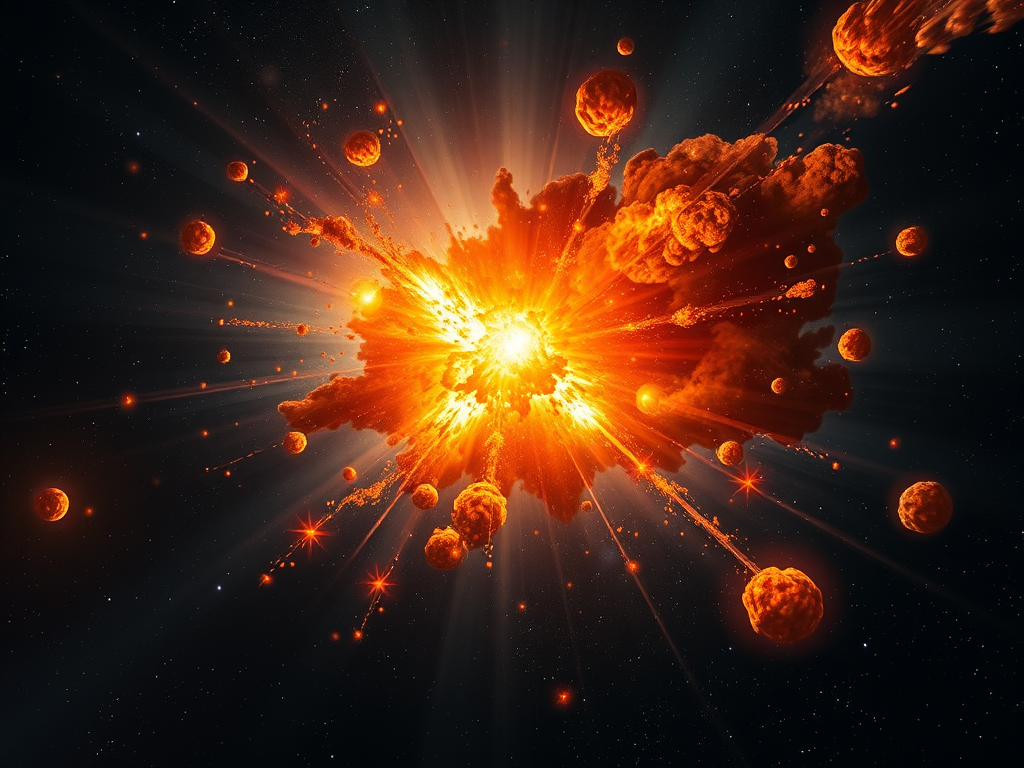
Stellar Fireworks: Unveiling the Mysteries of Supernovae
The universe is a vast and dynamic expanse, filled with celestial wonders that have captivated humanity for millennia. Among these cosmic marvels are supernovae, cataclysmic explosions that mark the end of a star’s life cycle. These events are not only visually stunning but also play a crucial role in shaping the universe as we know it.
The Genesis of Stars: A Cosmic Ballet
Stars are born within vast clouds of gas and dust known as nebulae. Gravity acts as the choreographer, pulling these particles together, causing them to collapse and heat up. As the core temperature rises, nuclear fusion ignites, transforming hydrogen into helium and releasing immense amounts of energy. This energy counteracts gravity’s inward pull, creating a delicate balance that sustains a star for millions or even billions of years.
Supernovae are broadly classified into two main types
- Type I supernovae: These occur in binary star systems where a white dwarf accretes matter from its companion star. Once the white dwarf reaches a critical mass (known as the Chandrasekhar limit), it undergoes a runaway thermonuclear explosion, obliterating the star.
- Type II supernovae: These are the result of the core collapse of massive stars. When the core collapses, it rebounds, sending a shockwave through the star’s outer layers, causing them to explode.
Stellar Trajectories: A Mass-Driven Destiny
The path a star takes during its lifetime depends primarily on its initial mass. Low-mass stars, like our Sun, eventually exhaust their hydrogen fuel and expand into red giants. They then shed their outer layers, forming planetary nebulae, and leaving behind a dense core known as a white dwarf.
Massive stars, on the other hand, have a more dramatic fate. They fuse heavier elements in their cores, progressing through a series of nuclear reactions until they reach iron. Iron fusion consumes energy rather than releasing it, disrupting the star’s equilibrium. The core collapses under its own gravity, triggering a violent explosion – a supernova.
Here’s a detailed breakdown of the different trajectories based on mass:
1. Low-Mass Stars (less than 8 solar masses)
These stars, like our Sun, are the most common type in the universe. They have a long and relatively stable life cycle, spanning billions of years. They primarily fuse hydrogen into helium in their cores, maintaining a delicate balance between gravity and radiation pressure. As they age, they gradually exhaust their hydrogen fuel and expand into red giants. Eventually, they shed their outer layers, forming planetary nebulae, and leaving behind a dense, Earth-sized core called a white dwarf. White dwarfs slowly cool and fade over trillions of years.
2. Intermediate-Mass Stars (8-25 solar masses):
These stars have a shorter lifespan than low-mass stars, lasting millions of years. They are massive enough to fuse heavier elements beyond helium, such as carbon, oxygen, and neon. As they approach the end of their lives, they undergo a series of nuclear reactions, culminating in the formation of an iron core. Iron fusion consumes energy rather than releasing it, disrupting the star’s equilibrium. The core collapses under its own gravity, triggering a violent explosion known as a Type II supernova. The outer layers of the star are ejected into space, enriching the interstellar medium with heavy elements. The core may collapse further, forming a neutron star or a black hole.
3. High-Mass Stars (more than 25 solar masses)
These stars are the most massive and luminous in the universe, but they have the shortest lifespans, lasting only a few million years. They rapidly fuse heavier elements, progressing through a series of nuclear reactions until they reach iron. Like intermediate-mass stars, they undergo core collapse and explode as Type II supernovae. However, they can also explode as Type Ib/c supernovae, which are characterized by the absence of hydrogen lines in their spectra. These supernovae are thought to occur when the star has lost its outer hydrogen envelope before the core collapse.
4. Very High-Mass Stars (more than 100 solar masses)
These stars are extremely rare and live for only a few hundred thousand years. They fuse elements even heavier than iron, such as silicon and sulfur. Their cores eventually become so massive that they collapse directly into black holes without producing a visible explosion. This process is known as a “failed supernova” or “unnova.”
5. Factors Influencing Stellar Trajectories: Beyond Mass
While mass is the primary determinant of a star’s fate, other factors can also influence its trajectory. These include:
- Metallicity: The abundance of elements heavier than helium in a star’s composition. Stars with higher metallicity tend to evolve differently than those with lower metallicity.
- Rotation: The speed at which a star rotates. Rapidly rotating stars can mix their interiors more efficiently, affecting their evolution.
- Magnetic fields: The strength and configuration of a star’s magnetic field. Magnetic fields can influence the transport of energy and matter within a star.
Conclusion: A Tapestry of Stellar Lives
The diversity of stellar trajectories is a testament to the complex interplay of physical processes that govern star formation and evolution. Mass plays a crucial role, but other factors also contribute to the tapestry of stellar lives that illuminate the universe. By studying these processes, we gain a deeper understanding of the cosmos and our place within it.
Type Ia Supernovae: A Different Path to Explosion
Type Ia supernovae don’t follow the same mass-dependent path as Type II supernovae. Instead, they originate from a specific scenario involving a binary star system:
- Binary System with a White Dwarf: Type Ia supernovae occur in binary systems where one of the stars is a white dwarf, the dense remnant of a low-mass star. The other star can be anything from a giant star to an even smaller white dwarf.
- Accretion of Matter: The white dwarf’s intense gravity pulls matter (primarily hydrogen and helium) from its companion star. This process is known as accretion.
- Reaching the Chandrasekhar Limit: As the white dwarf accretes matter, its mass increases. Eventually, it reaches a critical mass known as the Chandrasekhar limit, which is approximately 1.44 times the mass of our Sun.
- Runaway Thermonuclear Explosion: At this critical mass, the pressure and temperature within the white dwarf become so extreme that runaway carbon fusion ignites throughout the star. This sudden and violent release of energy causes a catastrophic explosion, completely obliterating the white dwarf in a Type Ia supernova.
Other Types of Type I Supernovae (Type Ib/c)
While Type Ia supernovae are the most common type of Type I, there are also Type Ib and Type Ic supernovae. These are thought to originate from massive stars that have lost their outer hydrogen envelopes before core collapse. This can happen due to strong stellar winds or interactions with a companion star.
- Type Ib: These supernovae lack hydrogen lines in their spectra but show helium lines.
- Type Ic: These supernovae lack both hydrogen and helium lines in their spectra.
Key Differences Between Type I and Type II Supernovae
| Feature | Type Ia | Type II | Type Ib/c |
|---|---|---|---|
| Progenitor | White dwarf in binary system | Massive single star | Massive star that has lost its outer hydrogen envelope |
| Mechanism | Thermonuclear explosion | Core collapse | Core collapse |
| Spectra | Strong silicon lines, no hydrogen lines | Hydrogen lines present | No hydrogen lines, may or may not have helium lines |
| Light curve | Characteristic, used as standard candles | More varied | Similar to Type II, but less luminous |
Conclusion: Diverse Paths to Stellar Demise
The formation of Type I supernovae, especially Type Ia, highlights the diversity of stellar evolution pathways. While mass is the dominant factor for most stars, binary interactions and mass transfer can lead to unique scenarios that result in these spectacular explosions. Each type of supernova provides valuable insights into the lives and deaths of stars, contributing to our understanding of the vast and dynamic universe.
The Path to Supernovae: A Matter of Mass
The path a star takes is determined by its mass. Low-mass stars follow the red giant-white dwarf path, while massive stars are destined for a supernova. The reason for this lies in the ability of massive stars to fuse heavier elements, eventually leading to the core collapse that triggers a Type II supernova. In the case of Type I supernovae, the mass transfer in binary systems pushes the white dwarf beyond the Chandrasekhar limit, leading to a thermonuclear explosion.
The Significance of Supernovae: Cosmic Alchemy and Galactic Evolution
Supernovae are not only destructive events but also creative forces. They are responsible for synthesizing heavy elements, such as gold and platinum, which are dispersed into the interstellar medium. These elements become the building blocks for new stars and planets, enriching the universe’s chemical diversity. Supernovae also play a role in triggering star formation and shaping the structure of galaxies.
Conclusion: A Universe of Wonders
Supernovae are spectacular events that illuminate the intricate workings of the universe. They are a testament to the constant cycle of stellar birth, life, and death, a cosmic ballet that has been playing out for billions of years. By understanding these celestial fireworks, we gain a deeper appreciation for the vastness and complexity of the cosmos and our place within it.
 In the Pursuit of excellence
Leave a comment